How to Write a "Why This Major" Essay (+ Adjacent Majors)
Aug 27, 2026
The "why this major" essay looks like the easiest supplemental on the list. It's usually short — sometimes 100 words — and the question seems obvious. Why do you want to study this? Because you like it.
That answer fails. What the prompt is really asking is whether you're a good match for this field at this school, and whether anything in your record proves it. The essay works when it connects the major to what you've already done. It falls flat when it's a statement of enthusiasm with no evidence underneath.
There's also a strategic layer most students miss: at many colleges, the major you name affects your odds of admission. Get that choice right and the essay gets easier to write.
What the Prompt Is Actually Asking
Purdue's version is about as bare as it gets: Briefly discuss your reasons for pursuing the major you have selected — in roughly 100 words.
Short, but it still needs the pre-work. In that space you have to show two things: that you understand what this major actually involves at this college, and that your high school experience prepared you to contribute to it.
That means research first. Look at the major on the school's own site: the degree requirements, the courses you'd take, the electives on offer, the research happening in that department. Majors with the same name differ enormously from school to school — different requirements, different emphases, different opportunities. A "why this major" essay that could describe the same major anywhere isn't answering the question.
Brainstorm Your "Why This Major" Essay Before You Draft
Paste these questions into that college's document and answer them fully before writing a word. It's the step that makes draft one fast.
What do you value most about this major at this college? Be specific to this program — a required course sequence, an emphasis the department is known for, a research area, an unusual elective. If you're undecided, explain instead how the college's course offerings will let you explore your interests.
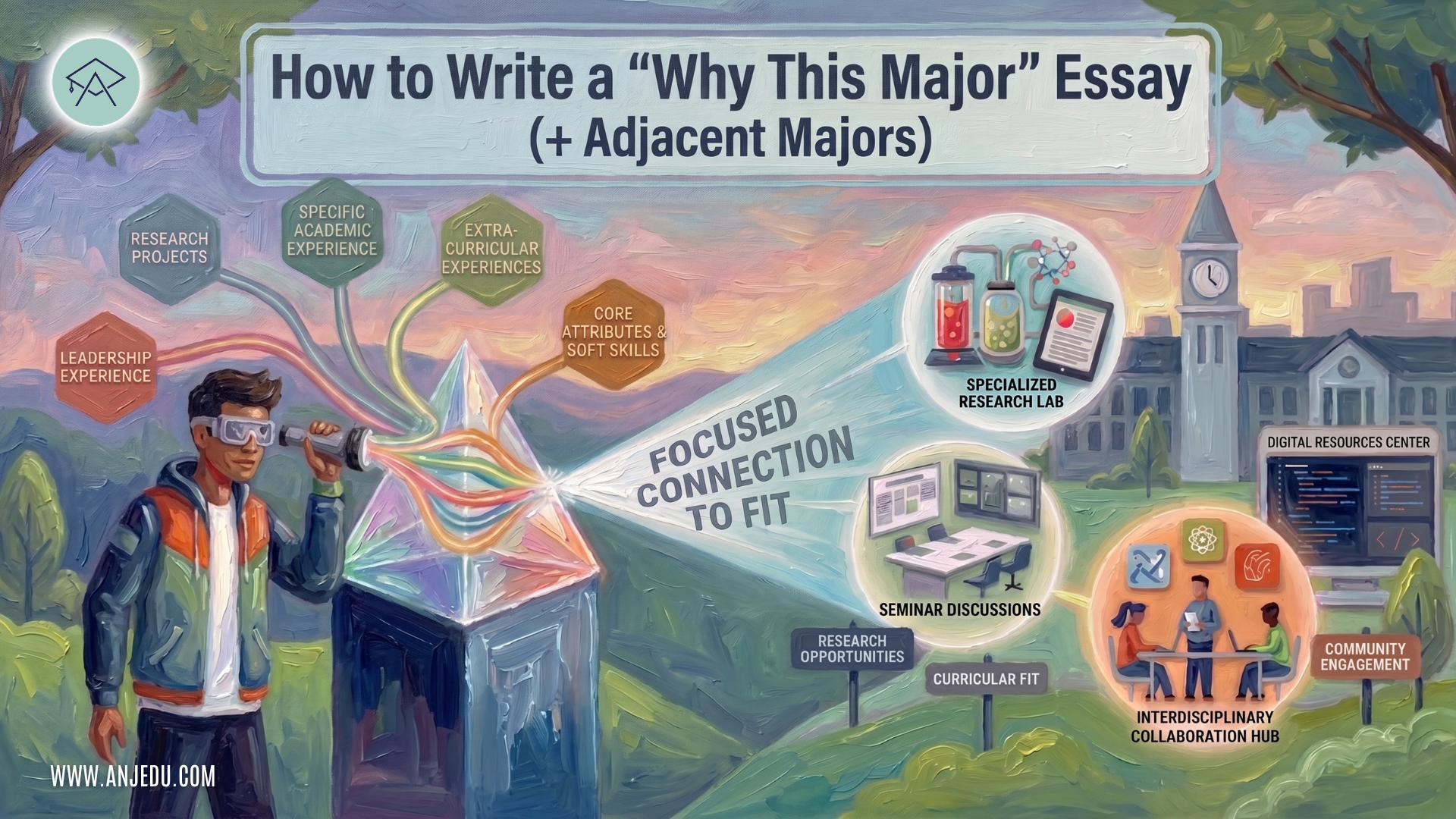
What in your record makes you a match? List the high school courses you've taken, plus extracurriculars, summer programs, internships, competitions, research, family responsibilities, and jobs that show you're prepared for the way this major is described here.
That second question is where the essay actually comes from. If you're heading into math and you took AP Calculus, don't just name the course — say what you enjoyed about it that made you decide to major in the field. If a major includes a component you've already touched through a class or project, connect them explicitly.
And if you don't have direct experience, look for transferable skills. A job that required you to coordinate with a team built collaboration skills you'll use in group projects. Research over a summer — even in a different field — built research skills that carry. Family responsibilities build time management and reliability. The point isn't to have a perfect résumé for the field; it's to draw a specific, honest line from something you've done to something you'll do.
Don't Repeat Your "Why Us"
If a college asks both a "Why Us" essay and a "why this major" essay, don't say the same things twice.
The division is simple: the major goes in the major essay. Everything else — professors, student organizations, campus culture, mission, research opportunities beyond your field — goes in the "Why Us." You'll still name the major there as your primary academic reason for applying, since academics always come first in a "Why Us." But the deep dive on the field itself belongs here.
Reading the same paragraph twice tells an admissions officer you had one idea and stretched it. Two distinct essays tell them you did the work.
The Strategy: Capped and Impacted Majors
Now the part that affects your odds.
At many large public universities and selective private schools, certain majors are impacted or capped — they fill up fast and admit at much lower rates than the school overall. The usual suspects are computer science, business, engineering, psychology, and economics.
If you apply directly into one of those, you're competing in the most crowded pool at that school. An adjacent major — one that's related to what you want but less oversubscribed — can meaningfully improve your chances while still giving you the training you're after.
Penn State is a useful illustration, because a large public university often has dozens of options students never look at. Near computer science, it offers Social Data Analytics, an interdisciplinary B.S. combining social science with statistics, mathematics, information science, and computer science. Near business, it offers Enterprise Technology Integration, a B.S. blending information technology, application development, and business fundamentals with systems integration coursework. Neither is a consolation prize. Both are real degrees with real career paths — they're simply less crowded than the headline majors next door.
A few practical notes on the strategy:
- Colleges rarely publish admit rates by major. You can contact the admissions office directly and ask; sometimes they'll tell you.
- Look at the full major list, not just the famous ones. Large publics often have hundreds of programs, including interdisciplinary ones built from several fields.
- Consider the adjacent path for your reach and lottery schools in particular, where the odds gap matters most.
- Check what else is possible — double majors, a major plus a minor, or a build-your-own major at schools that allow it.
Program offerings change, so verify what a school currently lists before building an essay around it.
Make the Strategy Honest
Here's the catch, and it matters: the adjacent-major strategy only works if your essay backs it up.
If you name a less-crowded major, your "why this major" essay has to connect authentically to that field — its courses, its methods, its questions. A reader who senses you picked a side door and can't explain why you want to walk through it will not be persuaded. But a student who genuinely finds social data analytics compelling, and can trace that interest to a statistics class and a project analyzing survey data, has both a stronger essay and better odds.
So do the research on the adjacent major with the same seriousness you'd give your first choice. If you can't write a convincing essay about it, it's the wrong pick.
A Few Final Rules
Name a first and second choice. Many colleges — especially public ones — ask for both. Decide deliberately rather than filling in a blank at the last minute.
Undecided is fine. But you'll still need to name two or three areas of interest and show what you've done to explore them, because an essay will almost certainly ask.
Keep examples in high school. Middle school and childhood can be mentioned in passing, but the evidence should come from the past four years.
Put your chosen majors at the top of that college's document. When you're juggling ten schools and different major choices at each, having them visible saves real time and prevents mistakes.
The Test
When your draft is done, ask: does this essay prove I'm ready for this specific major at this specific school — or does it just say I'm interested?
Interest is what every applicant has. Evidence is what separates them. Name the courses and projects that led you here, connect them to what this program actually offers, and the short essay that looked easiest on your list becomes one of the most persuasive things in your application.
This is part of our series on the college essay. For the full picture — the personal statement, the other supplementals, and every essay in between — see our main guide, The College Essay: Telling Your Standout Story.