
How to Build a College List: Schools You Love, Balanced for Fit and Merit Aid
Most college lists are not built. They just happen.
A name comes up at a soccer game. A neighbor's older kid went there and liked it. Your student sees a sweatshirt. By senior fall you have twelve schools that nobody ever sat down and reasoned through. And before you know it, the student has fallen in love with a college. It has become their "dream school."
That is the most expensive mistake in college admissions, and almost nobody catches it in time. Every decision downstream is constrained by that list: which essays get written, where demonstrated interest goes, which majors are worth targeting, and what you end up paying.
There is a personal cost too. When a family decides that one school holds the only key to a good future, they have set up a disappointment that was never necessary. By equating prestige and a low admission rate with self-worth and the only path to a rewarding and financially stable career, families narrow the field before they have looked at it. Students overlook excellent colleges that would have paid them to attend, and families either take on debt the degree will not pay back or deplete their retirement savings to avoid it.
The good news is that this is fixable with a process rather than with luck. Three steps, in this order. Define what your student actually needs before you name a single school. Assess real probability before anyone falls in love. Then treat college as the first step in designing a career, not the whole of it, since that path often runs through graduate or professional school. Families who work in that sequence land in April with several acceptances, real merit money, and a student genuinely excited about the options in front of them.
Building the list is the highest-leverage skill in this entire process, and it is learnable. The finished list has to pass two tests at once: every school on it has to be a real fit, and, unless money is no object, the list as a whole has to be shaped so merit aid actually shows up. That is the backbone of our True U College Admissions roadmap, and it is what the rest of this article walks through.
How Do You Build a College List? The Short Answer
- Define preferences before you name schools. Start with school names and you will spend the rest of the process inventing reasons they fit.
- Safety schools do not exist anymore. Outside community college and certain automatic-admission programs, nothing is guaranteed. Think in probabilities.
- Measure likelihood by the school's admission rate, not by how strong your student is. This is deliberately conservative, and it will protect you.
- Ten to fifteen schools, depending on academic profile. For nearly every profile, six of those should be likelies and targets, with three likelies. Reaches and lotteries get added on top of that base, never substituted into it.
- Lean into targets and likelies. This is where the best merit aid and the most accessible honors programs are.
- Balance is not the same as fit. A perfectly balanced list of schools your student would hate is still a bad list. Both tests have to pass: fit and balance.
- Two invisible factors decide selective outcomes. Yield and annual institutional agendas explain results that otherwise look random.
- Match list length to academic profile. A student near the top of their class should build a different list than a student in the top half.
- Go broad, then narrow. Generate twenty college options through filtering, then cut to your final number through research.
- Check merit behavior before you finalize. Schools that compete for students behave very differently from schools that do not.
- Track everything in one place. Our free College List Research Tracker holds one row per school and does the narrowing for you at the end.
- Get parents to sign off on the final list. This will make for a more aligned conversation when you have to make your final choice.
- Visit a variety of local colleges. Make sure you don't just focus on brand names. Include small to large, selective and less selective, and learn about honors colleges. This will help you have more context when you build your list. If possible, do these visits in 10th grade or the summer before 11th grade.
What Should You Look For in a College?
Do this after your student has some sense of possible majors and careers, and before any specific school enters the conversation.
The tool is simple. Take every criterion below and sort it into one of four buckets: must have, would be nice, do not care, absolutely not.
Sorting forces specificity that conversation never does. Families are consistently surprised by the results. Things you assumed were essential turn out to be negotiable, and things nobody ever mentioned turn out to be deal-breakers.
Academic and Financial
Major. This one is always a must-have. There is no reason to research a school that does not teach the subject. If your student is drawn to interdisciplinary work, a self-designed major, or a double major, write that down now, because schools vary enormously in how much flexibility they allow.
Honors colleges. For a strong student, an honors college at a large public university can deliver much of what a small private college offers at a fraction of the price. The typical package includes smaller seminar-style classes, priority registration, dedicated housing and advising, research funding, and direct access to faculty, wrapped inside a university with the course catalog and facilities no small college can match. Many honors programs also come attached to substantial merit aid, and some flagships use them explicitly to recruit students who would otherwise leave the state. The result is a peer group of high achievers, a smaller academic community, and a bill that often lands well under what a comparable private school would cost after aid.
Quality of teaching and faculty. A must-have for most students. It occasionally slides to "would be nice" for students headed into very technical or hands-on fields.
Need-based financial aid. This depends largely on your family's income and assets. One change worth knowing: since the 2024-25 FAFSA, having more than one child in college at the same time no longer reduces your Student Aid Index, the number used to help determine federal aid eligibility. The FAFSA still asks how many family members will be in college, but that number is no longer used in the SAI calculation. Schools that require the CSS Profile may still account for multiple children in college when awarding their own institutional aid, so check each school's financial aid page to see whether the Profile is required and how institutional aid is calculated. Financial aid officers can also make case-by-case adjustments for special circumstances, and multiple children in college is a common request. Approval is not guaranteed, and policies vary by school.
Merit scholarships. Merit money is awarded on grades, scores, leadership, and talent rather than on financial need. Keep in mind that it is not only academic. An artist's portfolio or a sustained record of service can produce serious offers. Merit scholarships are often an enrollment tool for the admissions office to attract strong students to their campus, so never assume your child does not qualify. Look at how each school defines its criteria.
Return on investment (what the degree returns vs. what it costs). Families increasingly look at four numbers:
- The four-year graduation rate, since every extra year is another full year of cost
- Median earnings one and four years after graduation
- Placement rates into medical, law, and other graduate programs
- How effectively career services and the alumni network open doors to internships and jobs. Research these last two carefully, since schools measure and report them very differently, and read earnings figures alongside the school's mix of majors, which drives that number more than school quality does. It would be most helpful to have a major-by-major breakdown, which might be more difficult to find but worth asking for.
Location and Environment
Geography. Open an actual map. Which regions genuinely appeal? In state or out? Which cities, and which ones are out of the question?
Campus setting. There are four, and undergraduate life feels different in each one.
| Setting | What it means | Example |
|---|---|---|
| Urban | A self-contained campus inside a city | UT Austin |
| Uber-urban | Buildings scattered through a city, no real campus | New York University |
| Suburban | A campus outside the city or in a college town | Princeton, Brandeis |
| Rural | Countryside, well away from a city | Colgate |
One caution worth raising with your student. A lot of teenagers are drawn to big cities right now, and most of them overestimate how much time they will have to use one. Between coursework and clubs, the week fills up fast.
Size. Small runs from under 500 students up to about 4,000. Medium is roughly 4,000 to 8,000. Large is 8,000 to 15,000, and very large is anything above 15,000.
Students often rule out small schools because they assume opportunity scales with headcount. It frequently does not. Smaller schools with strong academics tend to deliver much better access to professors and research and more focused instruction.
Climate. Irrelevant to plenty of students and genuinely important to others, especially anyone whose mood tracks with sunlight or who wants winter sports within reach.
Diversity. Break it apart. Racial, geographic, and political diversity are separate questions, and your student may care about them very differently.
Safety. Urban campuses tend to score lower on safety, with a few exceptions. Beyond the rating, ask what your student wants it to feel like to walk around at night in the neighborhood where the college is located.
Campus culture. This is the hardest factor to research and the one students most often get wrong, since every school's marketing says collaborative and welcoming. Ask concrete questions instead. Does campus empty out on weekends? Is Greek life the main door into a social life or one option among many? Do students in intro science courses compete or study together? A student who does not fit transfers or takes an extra year, and both are expensive. Belonging is not just a comfort issue either: a number of studies have shown that students who feel connected to their campus earn higher grades and are likelier to stay enrolled. And remember: tour guides give the brochure answer, so go around them: the student newspaper's opinion page, the school's subreddit, and current students on what they wish they had known. If your student needs a specific environment to do their best work, culture is a must-have. Even for adaptable students, campus culture shapes all four years.
Five Numbers Worth Writing Down
These five apply to nearly every student, and they are easy to look up during research rather than guess at.
- Freshman retention rate. How many students come back for sophomore year. It is the closest thing to a satisfaction score that colleges publish.
- Graduation rate. Whether students finish, and how long it takes them.
- Job and graduate school placement in the intended field. This connects the academic decision to the outcome you are actually paying for.
- Student-to-faculty ratio and average class size. At many large universities, introductory courses are taught by doctoral students rather than professors. That is not automatically bad. It should just be something you knew going in.
- Median earnings one and four years after graduation. When possible, as explained above in the ROI section, try to get these numbers for the majors you are interested in instead of a school average across all majors.
A Few More Criteria
Housing. Some schools guarantee four years. Some guarantee one. At some, most students live off campus.
Religiously affiliated schools. These vary enormously, and some require chapel attendance or coursework. Do not write off the whole category until you have examined what those requirements are for each school.
Women's colleges. Many belong to consortia with nearby co-ed colleges, so students cross-register, share libraries, and have a co-ed social life while keeping a women's college as their home campus and benefiting from single gender housing. Bryn Mawr and Haverford work this way. Graduates often point to that environment as the thing that gave them footing in male-dominated fields later.
School spirit. Big athletics and campus tradition are a must-have for some students and a hard no for others.
Greek life. The system has earned real criticism around recruitment and hazing. It also produces housing, service work, social structure, and alumni networks that matter after graduation. Students tend to hold strong opinions in one direction or the other. Write down which.
Activities to continue. List what your student wants to keep doing. Where a club does not exist, starting one is usually possible, and sometimes that is the better story anyway.
What Are Likely, Target, Reach, and Lottery Schools?
Do Safety Schools Still Exist?
Retire the term. Outside of community college, where you show up and enroll, almost nothing is guaranteed.
Automatic admission comes closest, and even it has a catch. Programs like the one at UT Austin guarantee admission to the university for in-state students above a class rank cutoff (top 5% in 2026-2027), but they do not guarantee the major your student asked for.
So we work in probability instead.
The Five Tiers, Defined by Admission Rate
We define likelihood by the school's admission rate, not by how strong the student is.
That will strike some families as backwards, so here is the reasoning. Three factors drive our college list balancing strategy: competition, yield, and institutional priorities.
The first is competition. No matter how accomplished your student is, competition at selective schools is fierce enough that individual strength stops predicting outcomes. As colleges require fewer supplemental essays, application volume climbs, and admission rates fall further.
The second is yield, the share of admitted students who actually enroll. Colleges manage it closely, and protecting it produces results that make no sense on paper. A school that doubts a student will enroll may pass on them regardless of qualifications.
The third is institutional priorities, meaning the mix each school decides it needs that year to shape the class. Geographic balance, program needs, athletic recruitment: all decided behind closed doors, all invisible from the outside.
The next section walks through a real case where the second and third factors produced results that looked entirely random. Being conservative here is what produces a spring full of acceptances and scholarship offers instead of one full of letdowns and sticker shock.
| Tier | Admission rate |
|---|---|
| Likely | 70 percent and above |
| Target | 50 to 69 percent |
| Reach | 30 to 49 percent |
| Lottery | 15 to 29 percent |
| Super Lottery | Below 15 percent |
If you have seen the terms reach, match, and safety schools elsewhere, this is the same idea with more accuracy. Our targets are what most people call match schools, and we split the old reach category into three, because a 40 percent school and a 4 percent school are nothing alike.
The split between lottery and super lottery matters more than it looks. A school admitting 20 percent of applicants and a school admitting 4 percent are not the same bet, and lumping them together lets a list drift toward the bottom of the range without anyone noticing.
Lean into the targets and likelies. Treat them as the good part of the list, not the obligation. This is where the real merit money lives and where honors programs are actually within reach.
The principle underneath is positioning. When your student sits near the top of a school's applicant pool, everything improves at once: admission odds, scholarship dollars, honors access, faculty attention, and how the four years actually go.
Why Do Strong Students Get Rejected From Less Selective Colleges?
One Student Whose Results Made No Sense
We worked with a student whose profile was exceptional on every dimension. Top grades, top class rank, top scores, a national athletic title, leadership in the arts and in service work, and completed research with a mentor.
Then the decisions came in, and they looked arbitrary.
One of her acceptances came from Stanford, which admits under 4 percent of applicants. One of her denials came from Santa Clara, a school that admits 48 percent. Two further denials came from schools admitting roughly 6 percent, well above the rate of the school that took her. And a university far less selective than several of her acceptances put her on its waitlist.
Families see results like this every year and conclude the process is random. It is not. The logic is real. It is just not published anywhere.
Two things explain almost all of it.
What Is Yield, and Why Does It Get Students Rejected?
Colleges forecast yield hard, using models that weigh things like income indicators, geography, and how much interest your student has shown. If the model says an admitted student probably will not come, the school has an incentive to deny or waitlist instead.
That is exactly what happened to our student at the less selective schools. They did not doubt she could do the work. They doubted she would show up.
The incentive is structural, and worth understanding. A school that badly misjudges its yield either over-enrolls and runs out of housing, or under-enrolls and blows a hole in its budget. A high yield also signals desirability to everyone watching, and admissions leadership is often measured on how accurately the class was forecast. Early Decision exists in large part because it locks yield in.
When a school suspects it is being used as a fallback, denying or waitlisting protects the number. The practice has a name in the industry: yield protection.
This is why demonstrated interest is a real strategy in our process and not an optional add-on.
What Are Institutional Priorities in Admissions?
When I built this process, I drew on two decades of alumni interviewing for Princeton. Every year I watched extraordinary candidates get in while equally extraordinary candidates did not, and I had long conversations with admissions staff about why.
Here is what I learned. A school at that level can fill every seat ten times over with students who are equally qualified. Merit cannot break the tie, because merit does not distinguish the pool.
So institutional need breaks it instead. Each year, leadership sets goals based on what the current student body is missing.
Say the orchestra is losing its principal cellist and nobody on campus can take the chair. Among ten equally qualified applicants, the cellist has an advantage that appears nowhere on a transcript. Or the class is thick with students from New Hampshire and thin on Montana. You can guess how that one resolves.
These priorities are confidential, they change every year, and they cover geographic balance, program needs, athletic recruitment, donor relationships, and, at schools that still practice it, legacy.
I am not telling you this to make you cynical. I am telling you because it is the reason a balanced list matters. Some of this sits outside your student's control, permanently, and the list is how you account for that.
How Many Colleges Should You Apply To?
Most students should apply to ten to fifteen colleges. Ten is right for a student in the top half of their class, twelve for the top quarter, and fifteen for students in the top 2 percent (can be extended to top 5-10 percent in some cases).
List length should track academic profile. A stronger profile earns more reaches and lotteries. It never earns fewer likelies and targets.
Read the table below left to right and the pattern is clear. As the profile strengthens, schools get added on the right side. The left side barely moves.
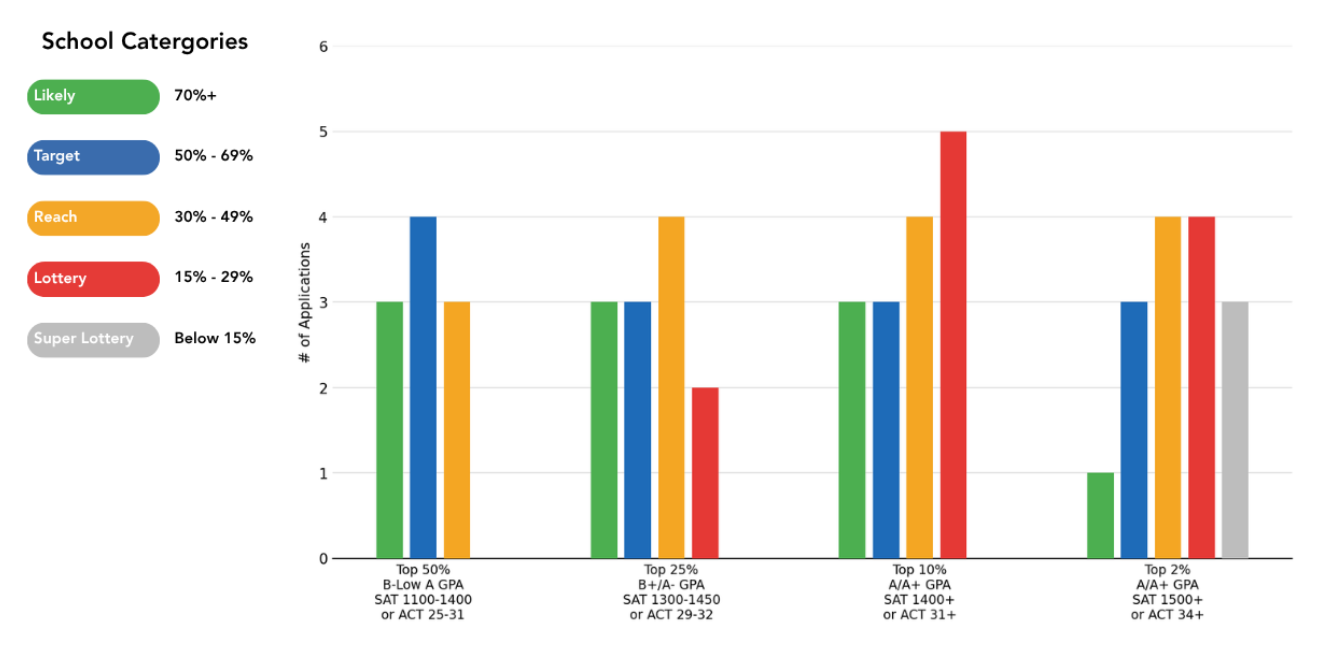
View this chart as a table
| Academic profile | Likely | Target | Reach | Lottery | Super Lottery | Total |
|---|---|---|---|---|---|---|
| Top 50% B to low A GPA, SAT 1100-1400 or ACT 25-31 |
3 | 4 | 3 | 0 | 0 | 10 |
| Top 25% B+/A- GPA, SAT 1300-1450 or ACT 29-32 |
3 | 3 | 4 | 2 | 0 | 12 |
| Top 10% A/A+ GPA, SAT 1400+ or ACT 31+ |
3 | 3 | 4 | 5 | 0 | 15 |
| Top 2% A/A+ GPA, SAT 1500+ or ACT 34+ |
1 | 3 | 4 | 4 | 3 | 15 |
A student in the top half of the class applies to ten schools and none of them are lotteries. That is not a limitation. It is the shape of a list that produces offers.
Notice too that super lottery schools appear in exactly one row. Below 15 percent, admission stops being predictable for anyone, which is why we reserve that tier for students already positioned at the very top of those applicant pools, and why even they only apply to three.
The top 2 percent row is the one exception to our own rule. Every other profile carries six likelies and targets with three likelies underneath. That row carries four, with a single likely. It is a deliberate trade for a student whose profile is particularly aligned, and it is the only place we make it.
If your student is in the bottom half of the class with a C average and low or no test scores, a different plan may make more sense. There are several options:
- Start at community college and transfer. This proves college-level performance with an actual college transcript, and it is by far the least expensive way to do it.
- Take a structured gap year built around a job or internship, a substantial project, and college-level classes. Colleges look favorably on gap years, as long as the year was genuinely designed rather than drifted through. Use the essays to show growth, and use the work itself to demonstrate that whatever caused the lower grades has been addressed. The goal is to leave admissions confident that your son or daughter will thrive on their campus.
- Apply to colleges with admission rates over 90%, provided they make financial sense. Go through the list with your high school counselor, comparing the profiles of students your school has sent to those colleges in past years, so you can see whether your student is in the ballpark.
Whichever route you take, one number matters more than the admission rate.
At colleges that admit almost everyone, check the graduation rate first. Many near open-access schools admit the great majority of applicants and graduate fewer than half of them, which tells you how much support students actually get once they arrive.
Paying for two years and leaving without a degree is the worst financial outcome in this entire process, worse than a gap year and far worse than community college, because you carry the cost without the credential.
Look at the six-year rate here rather than the four-year rate we mentioned earlier in the section on ROI, since students on these paths often need the extra time and the four-year number will understate the school.
Compare the rate against the other schools on your list, and ask the admissions office directly why the number is what it is. You can pull these numbers in seconds on College Navigator or College Scorecard.
What Is the Best Way to Keep Track of College Research?
One spreadsheet, filled in as you go, from the first search through the final decision.
We built ours and we give it away. Make a copy of the College List Research Tracker before you look up a single school, because the value comes from filling it in as you research rather than trying to reconstruct it later.
Free download The College List Research Tracker One row per school. Admission rate, tier, mission, culture, majors, notes, and a one to ten rating that does the narrowing for you at the end. Make a copy (opens in a new tab)That link will offer you your own copy straight away. Share it with whoever is helping, whether that is a parent, a counselor, or both.
One row per school. Name, admission rate, and tier up front, then a column each for the school's mission, its culture, and your first and second choice majors there. After that, general research notes, info session notes, visit notes, and an overall rating from one to ten.
That last column is the one that does the work. When it is time to cut twenty schools down to a final list, a set of honest ratings makes the decision for you. Without them you will be arguing from memory and enthusiasm, which is how lotteries end up outnumbering likelies.
How Do You Find Colleges That Match Your Preferences?
Where Can You Search for Colleges for Free?
Use College Navigator. It is free, run by the federal government, and it looks like it was designed in 2003. Ignore that. It does side-by-side comparison, saves your results, and exports to a spreadsheet, which is all you need.
Feed it the preferences you sorted earlier. Pick states off the map, set a distance from your zip code if that matters, and select the majors.
Limit results to four-year bachelor's programs. Include public and private nonprofit schools. Leave out for-profit institutions.
Two filters to handle carefully. Do not filter on published tuition, because sticker price tells you almost nothing about what you will actually pay. And set your enrollment range generously, because these filters are literal, and a school that misses your cutoff by 400 students will vanish from results even if it is perfect.
Run the admission rate filter one tier at a time. Search for likelies, then targets, then reaches, then lotteries. It is far more manageable than one giant search, and your list comes out already organized.
Which Colleges Give the Most Merit Scholarships?
Once you have about twenty saved and exported, run them against the buyers and sellers framework from education author Jeff Selingo.
The distinction is simple. Buyers compete for students and spend institutional money to win them, which is where the largest merit aid offers come from. Sellers have more applicants than they need and do not have to.
Three things to look at: whether a school behaves like a buyer, what share of its aid goes out without regard to financial need, and its yield. Low yield is good news here. It means the school is working to fill its class.
Then compare net price by income bracket rather than tuition. That is the number that reflects what families like yours actually pay.
If merit scholarships landed in your must-have column, do not skip this step.
How Do You Research a College Before You Apply?
Filtering finds schools that match numbers. It cannot tell you whether the school is a genuine fit, which is the part that decides whether your student stays and thrives. Four sources close that gap, and the notes you take here become the raw material for supplemental essays later, so take them properly.
- The Fiske Guide. Compiled by an independent editorial team rather than by the colleges themselves, so you get an outside view of academic strengths, social life, and campus atmosphere. Work from the index and read the entry for each school on your list.
- Niche.com. Look at three things: the report card at the top, the rankings by department and theme, and the student polls and reviews. Treat the grades as one input, not as truth. If a poll has fewer than fifty or a hundred responses, take it with a grain of salt. What you are hunting for is patterns, not individual reviews.
- The school's own website. Search it through Google rather than the site's internal search, which is almost always slower and worse. Look at the requirements for the major, what electives exist, and what the faculty in that department are actually researching. Do this across several schools and real comparisons emerge. Then read the mission statement and anything about campus culture, and take the virtual tour if there is one.
- Students on video. CampusReel hosts student-made content and interviews, which gives you a perspective the admissions office does not control. YouTube fills in the rest.
All of it goes in the tracker, in the row for that school, as you go. Notes written a week later are worth a fraction of notes written while the tab is still open.
The columns are built for this. Fiske, Niche, and student videos feed the general notes column. The school's own site feeds the mission and culture columns, and the majors column is where you record your first and second choice program at that specific school, which matters later when you write supplemental essays and again if a major turns out to be capped.
Rate each school one to ten before you move to the next one. That rating column is what makes the next step possible.
How Do You Narrow Down Your College List?
Use the ratings to bring roughly twenty schools down to the number your student's profile calls for, which is ten to fifteen depending on where they land in the chart above.
Then check the balance before you call it done. Unless your student is in the top 2 percent of the class, six of the schools should be likelies and targets, with three of those being likelies. Everything else sits on top of that base as reaches, lotteries, and in the case of the strongest profiles, super lotteries.
Last step: your student walks you through the final list, and you sign off on it.
This is not a formality. Families who reach real agreement in the fall avoid the much harder conversation in April of senior year, when an acceptance arrives from a school one parent never took seriously as a destination. Once the list is settled, the work moves to campus visits and demonstrated interest.
Is Your College List Actually Balanced?
A few questions worth sitting with:
- Did your list start from your student's stated preferences, or from names that were already in the air before anyone wrote preferences down?
- Counting only schools that admit more than half of applicants, how many are actually on the list?
- Would your student be genuinely happy at the least selective school they plan to apply to? If the honest answer is no, that school is not doing its job.
- Have you looked at net price by income bracket, or are you still working from the tuition figure on the website?
If you are ready to trade a "usual suspects" list of colleges for a customized list that fits your child and your family, we would like to help. Our approach brings structure, stronger merit outcomes, and options to choose from in April that your child is genuinely excited about.
If you know you need help, meet with us for a free Admission Strategy Session to explore working together and to answer your questions.
If you would like to learn more, we offer a free in depth masterclass on college admissions.
Frequently Asked Questions
The questions families ask most often once they start putting a list together.
Where to start
When should you start building your college list?
After your student has a working sense of possible majors and careers, and before demonstrated interest, campus visits, or essays begin. The list determines where interest gets directed and which supplemental essays get written, so building it late forces every one of those decisions into a shorter window. Junior year is the natural home for this work, and often our students' lists are finalized by the end of first semester.
Can you change your list during senior year?
Yes, and many families do. Adding a likely or target school in the fall is usually straightforward. What is difficult is adding schools late that require supplemental essays or separate application portals, which is another argument for settling the list early.
Finding your fit
Is it okay to apply to a school you would not be happy attending?
No, and this is the most common flaw we see in a list. If your student would be miserable at their likely schools, the list has no floor, and you will find that out in April rather than October. Every school on the final list should be one your student would be genuinely excited about.
Do you have to visit every college on your list?
No. Visit what you reasonably can, and use virtual tours, information sessions, and student-made video for the rest. What matters is that each school on the final list has been researched deeply enough that your student can say something specific about why it belongs there. For some schools, on campus visits do help, so be selective.
Looking beyond the rankings
Should you use college rankings to build your list?
Use them as one input and never as the spine of the list. Rankings measure whatever the publisher decided to measure, and some of it has almost nothing to do with your student's four years. Peer assessment is about 20% of the U.S. News National Universities ranking. This reputation survey filled out by administrators at other colleges, which tells you how a school is regarded rather than how it teaches. We prioritize fit over rank, because fit is what predicts whether a student finishes and thrives.
How does your college list affect merit scholarships?
More than any other decision in the process. Merit dollars concentrate at target and likely schools, where a strong applicant sits near the top of the pool, and at institutions actively competing to enroll their class. A list weighted toward lotteries may produce the occasional acceptance but with almost no money.
When it gets complicated
Does applying test optional change how you build the list?
It changes the filtering, not the framework. Test score ranges stop being a useful screen, so preferences, admission rate, and fit research carry more weight. Check each school's policy individually, since test optional, test blind, and test required all coexist and policies shift year to year.
What is demonstrated interest and does it affect which schools you list?
Demonstrated interest is the record a school keeps of your student's engagement: opening emails, visiting the website and exploring it thoroughly, attending sessions, visiting campus, applying early, explaining fit in supplemental essays. Many schools, especially those with lower or mid sized yield, use it to predict whether an admitted student will actually enroll. It is one of the reasons to keep the list at a size your child can genuinely engage with, because interest spread across twenty five schools is neither credible to the colleges nor realistic for your student.
What if you and your student disagree about the list?
Settle it before applications go out, not after decisions arrive. That is why we build parental sign-off into the process as an explicit step. The hard version of this conversation happens in April, when an acceptance arrives from a school one of you never accepted as a real destination and a deposit deadline is two weeks away.
Want more support building your college list?
We'll work with you from the first blank spreadsheet through the final list, helping you find the schools worth researching, cut the ones that only look good on paper, and keep the balance where it needs to be. Book here to get started with one of our advisors.
We're also committed to supporting all students with free resources like this article. Join our community and receive powerful tips you can apply today as you build your list and prepare your applications. From our free videos to AskAnji, our carefully curated and trained proprietary AI assistant available 24/7, we've got you covered.
Every student has a college where they will thrive. Let's find yours.