What Is a Good PSAT Score? What Your Junior's Score Means and How National Merit Works
Oct 12, 2026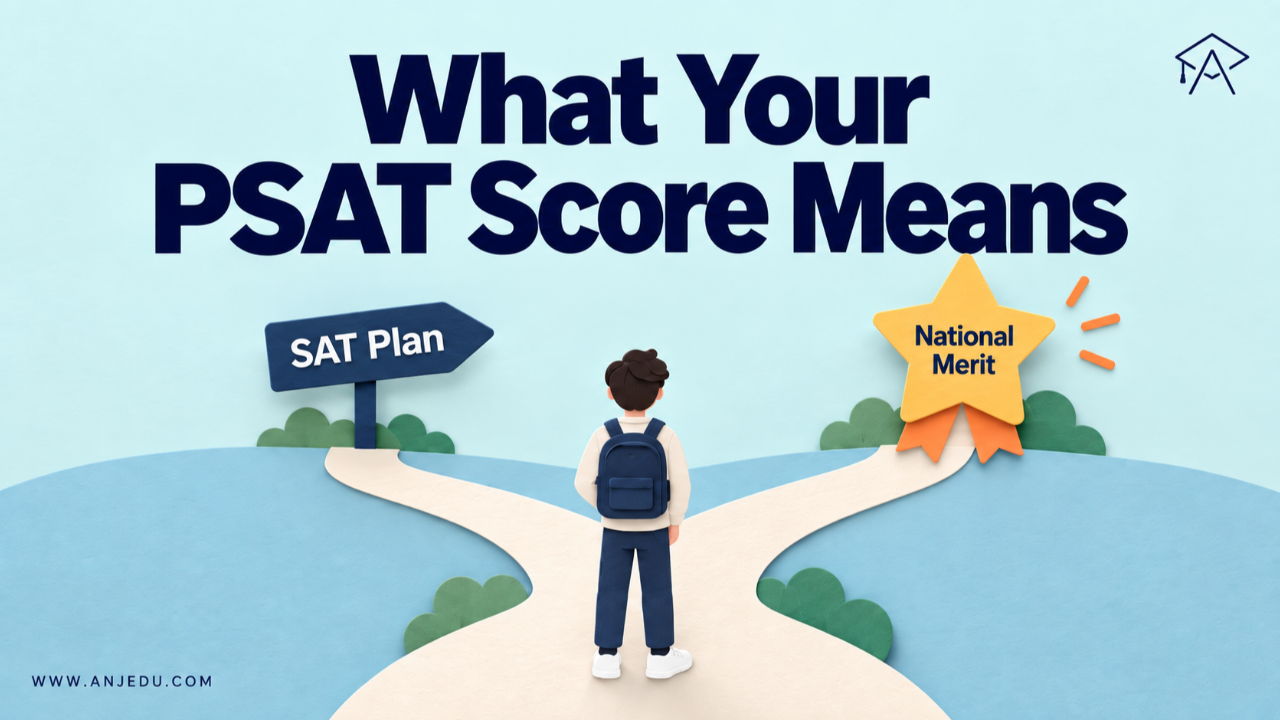
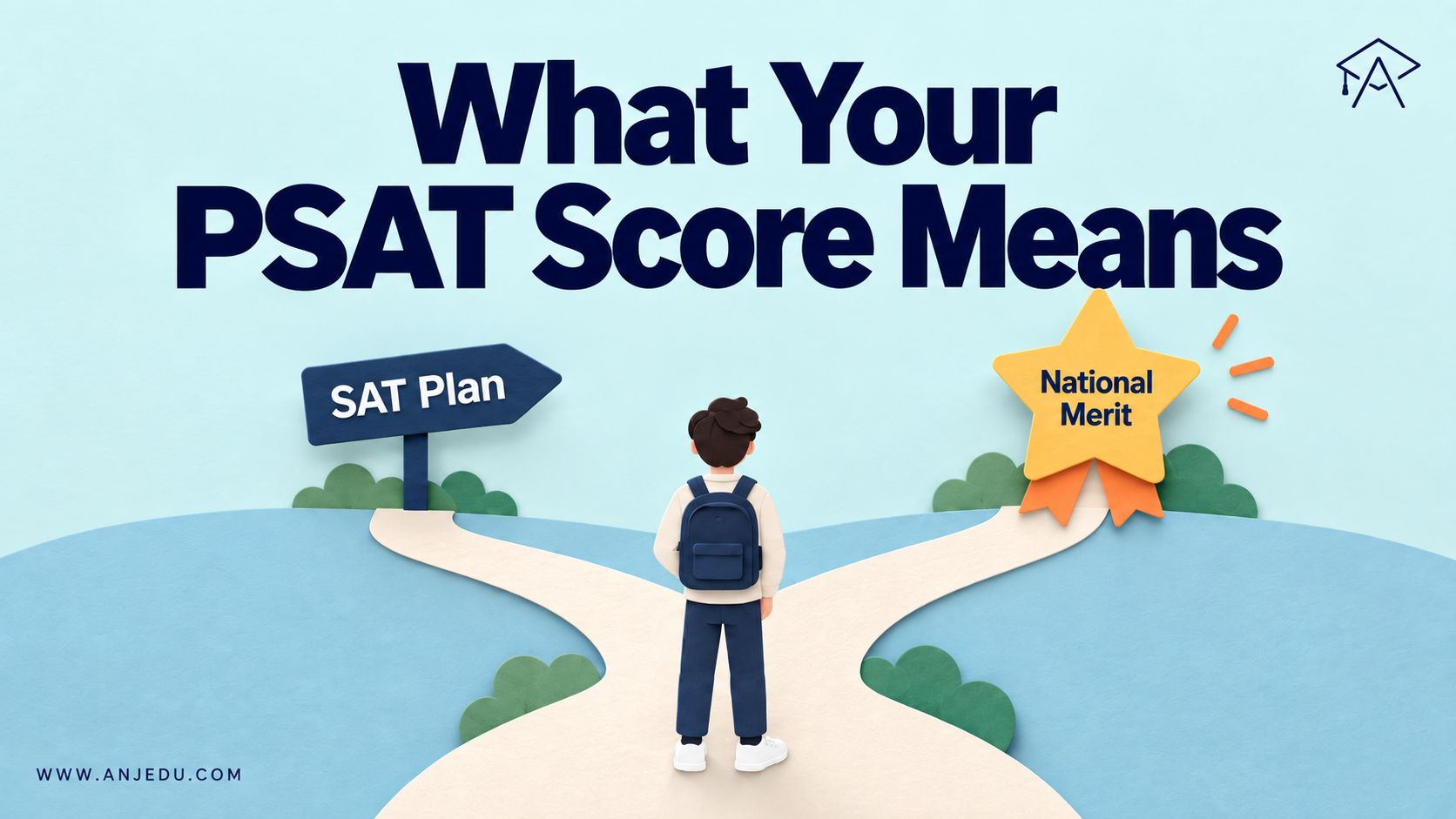
Your junior took the PSAT this fall, and a number came back somewhere between 320 and 1520.
Families usually ask two things next. Is that good? And does it matter?
The honest answer to both is: it depends on what you are using the score for. For most students, the PSAT is a planning tool. For a small number, it leads to National Merit recognition. And it is not a score colleges receive with an application.
Here is how to read the score, what counts as good for each purpose, and what to do next.
On This Page
- The Short Answer
- What Is the PSAT?
- PSAT Score Range: How the Test Is Scored
- What Is a Good PSAT Score?
- PSAT and National Merit: How the Selection Index Works
- From Semifinalist to Scholarship
- National Merit vs. the College Board National Recognition Program
- Do Colleges See PSAT Scores?
- What to Do With Your Junior's Score
- FAQ
The Short Answer
The PSAT/NMSQT and PSAT 10 are scored from 320 to 1520, with two sections scored 160 to 760 each.
College Board does not name one "good" PSAT score. It describes the PSAT/NMSQT and PSAT 10 as benchmark tests that track progress and give a sense of how a student may score on the SAT.
Because the SAT Suite shares a common scale, a PSAT score roughly reflects what the student would score on the other tests in the suite today. For reference, College Board puts the average SAT score around 1050 and says 1350 or higher is in the top 10% of SAT takers.
The most useful number on the report is often the percentile, which compares your student with others who took the same test.
For National Merit, the number that matters is the Selection Index: double the Reading and Writing score, add the Math score, and divide by 10.
Students on a standard four-year path must take the qualifying PSAT/NMSQT in 11th grade. Semifinalists are the highest scorers in each state, so the cutoff differs by state and by year.
College Board's National Recognition Program is a separate award with its own criteria. It is not National Merit.
What Is the PSAT?
The PSAT is College Board's family of in-school tests leading up to the SAT. There are three versions: the PSAT 8/9, the PSAT 10, and the PSAT/NMSQT.
The full name of the fall test, Preliminary SAT/National Merit Scholarship Qualifying Test, explains the confusion families run into. The PSAT/NMSQT is the qualifying test for the National Merit Scholarship Program, a competition for recognition and scholarships run by National Merit Scholarship Corporation (NMSC). NMSC describes the test as an initial screen for more than 1.2 million entrants each year.
NMSC cosponsors the test, so scores are sent to NMSC automatically, and students cannot opt out of that transfer. A student who does not want to be considered must contact NMSC directly.
PSAT Score Range: How the Test Is Scored
| Test | Total score | Section scores | Extra score |
|---|---|---|---|
| PSAT/NMSQT | 320 to 1520 | 160 to 760 | NMSC Selection Index, 48 to 228 |
| PSAT 10 | 320 to 1520 | 160 to 760 | None |
| PSAT 8/9 | 240 to 1440 | 120 to 720 | None |
Two parts of the report deserve more attention than the total.
The score range and percentiles. The report shows how much the score would likely vary on a different administration, and percentiles that compare your student with other test takers.
Knowledge and Skills. The report breaks performance into eight content areas, four in Reading and Writing and four in Math. This is where the PSAT earns its keep as a diagnostic.
What Is a Good PSAT Score?
It depends on the question you are asking.
For the PSAT 8/9, College Board says there are no good or bad scores. It is a diagnostic for planning high school.
For SAT planning, the common scale is the useful part. A PSAT score gives a rough preview of where your student would land on the SAT today. Compare that preview with the admitted-student averages at the colleges on your list rather than with a national number. College Board makes the same point: a score that is average at a highly selective school can sit in the top percentiles somewhere else.
For a quick benchmark, use the percentile on your student's report. Test prep companies publish estimates too. Kaplan, for example, says a PSAT score of 1280 or higher puts a student in at least the top 10%. Treat third-party figures as approximations. The percentile on your student's own report is the authoritative comparison.
For National Merit, "good" means a Selection Index high enough to clear your state's cutoff. A percentile won't tell you that, since percentiles are based on section or total scores rather than the Selection Index (Compass Prep, third-party).
| What you are using the score for | What "good" means |
|---|---|
| Diagnostic | Clear strengths, and gaps in skills your student has not yet covered in class |
| SAT planning | On track for the typical scores of admitted students at your target colleges |
| Percentile benchmark | Where your student ranks among others who took the same test |
| National Merit | A Selection Index at or above your state's Semifinalist cutoff |
| National Recognition Program | Top 10% in the relevant group, plus the GPA requirement |
PSAT and National Merit: How the Selection Index Works
NMSC screens entrants using the Selection Index, which appears only on PSAT/NMSQT reports. The formula doubles the Reading and Writing score, adds the Math score, and divides by 10.
A student with 700 in Reading and Writing and 680 in Math has a Selection Index of 208: (700 × 2 + 680) ÷ 10.
Because Reading and Writing counts twice, two students with the same total score can have different Selection Index scores.
Timing matters. Students planning the usual four years of high school must take the qualifying test in 11th grade. A sophomore who takes the PSAT/NMSQT is not entered in the competition and must test again as a junior. For the current cycle, the October 2026 PSAT/NMSQT is the qualifying test for the program ending in 2028.
Two levels of recognition. About 50,000 participants are recognized each year. More than 16,000 of them, the highest scorers in each state, are named Semifinalists in early September of senior year and notified through their schools. The remaining roughly 34,000 are named Commended Students and receive a letter of commendation, but they do not continue in the scholarship competition.
Cutoffs vary by state and change every year. For the Class of 2027, Compass Prep, a third-party test prep company, reports Semifinalist cutoffs ranging from 208 in the lowest-cutoff states to 223 in New Jersey, with the national Commended level at 208. Texas's cutoff was 219. Compass reports that all 50 state cutoffs fell from the prior year, so treat any single year's number as a rough guide.
Colleges hear about Semifinalists early. NMSC sends Semifinalist names to regionally accredited four-year U.S. colleges and universities.
From Semifinalist to Scholarship: What National Merit Is Actually Worth
Being named a Semifinalist is an honor, not a check.
Semifinalists must meet additional requirements to become Finalists, including a principal's endorsement and a record of very high academic performance through all four years of high school. The school's portion of the application also has a firm deadline. For Semifinalists named in fall 2026, the high school must submit its sections by October 7, 2026, and the date changes each cycle. NMSC expects about 95% of Semifinalists to reach Finalist standing.
Finalists are then considered for three types of awards: National Merit $2500 Scholarships, corporate-sponsored awards, and college-sponsored awards. A student can receive only one monetary award from NMSC. About half of Finalists win one.
College-sponsored awards go only to Finalists who report that college as their first choice. They are renewable for up to four years at the sponsoring school, with stipends of $500 to $2,000 per year.
That is the part families often misread. Most official National Merit awards are relatively modest.
The larger money, where it exists, usually comes from a college's own scholarship policy for high-achieving students. Some colleges offer significant scholarships, even full rides, to Finalists (Compass Prep, third-party). Those awards are set by each college, not by NMSC, so check each school's scholarship page directly and note the deadline in your master deadline sheet.
Commended Students are not shut out entirely. NMSC notes that some may be candidates for Special Scholarships funded by corporate sponsors, which typically depend on criteria such as a parent's employer.
National Merit vs. the College Board National Recognition Program
These are two different programs, and many websites blur them together.
National Merit is run by NMSC. It uses the junior-year PSAT/NMSQT Selection Index and state-by-state cutoffs, and it leads to scholarships for some Finalists.
The College Board National Recognition Program is an academic award run by College Board. Under current rules:
- Grade and residence: Students in 10th or 11th grade with a permanent address in the United States, a U.S. territory, or a U.S. military base, or who attend a DoWEA school, can claim up to three designations. U.S. citizenship is not required.
- GPA: Students need a cumulative GPA of B+ or higher (at least 3.3) by the time they submit.
- Scores: Students must score in the top 10% of test takers in their high school, among first-generation students in their state, or among rural and small-town students in their state. The alternative is a 3 or higher on two or more AP exams in 8th, 9th, or 10th grade.
Older pages still list a 3.5 GPA and narrower eligibility groups. Those rules are out of date.
The main benefit is visibility. Colleges use these awards to identify and contact high-achieving students who have opted in to Student Search Service.
Do Colleges See PSAT Scores?
Not the way they see SAT scores.
College Board sends PSAT scores to schools, and in many cases to districts and states. Sending scores to colleges as part of an application is an SAT process.
Colleges can learn about strong PSAT performance indirectly, for example through NMSC's Semifinalist list or through National Recognition Program awards for students opted in to Student Search Service.
For admission and for many merit scholarship cutoffs, the SAT or ACT is the score that counts. The PSAT's value is what it tells you before that test.
What to Do With Your Junior's Score
Treat the score as information, not a verdict.
Read the Knowledge and Skills section first. Weaknesses in content your student has not yet studied are expected. Weaknesses in content they have already covered are where to focus.
Build a testing plan before any test prep. Start with a diagnostic, compare the SAT and ACT formats, decide which test suits your student, and prep toward a specific test date. Most students benefit from sitting for the real test in the spring of junior year, which leaves room for one or two retakes in the fall of senior year.
Check the merit scholarship math. Many merit scholarships use SAT or ACT score thresholds. Use the PSAT to estimate how far your student is from the cutoffs at the colleges on their list. The size of that gap is what tells you whether a retake is likely to pay off.
If your student is a sophomore near the top of the scale, remember that only the junior-year PSAT/NMSQT counts for National Merit. That fall test is the one to prepare for.
If your student may be a Semifinalist, watch for school notification in early September of senior year. The Finalist application runs through early October, so put those dates on the calendar alongside early application deadlines.
Frequently Asked Questions
What is a good PSAT score?
It depends on your goal. College Board frames the PSAT/NMSQT and PSAT 10 as benchmarks for progress and a preview of SAT performance rather than setting one good score. Use your student's percentile for a quick benchmark, and compare the implied SAT score with admitted-student averages at the colleges on your list.
What is the PSAT score range?
The PSAT/NMSQT and PSAT 10 total scores run from 320 to 1520, with section scores from 160 to 760. The PSAT 8/9 runs from 240 to 1440.
What PSAT score do you need for National Merit?
There is no single score. Semifinalists are the top scorers in each state based on the Selection Index, so the cutoff varies by state and year. Third-party trackers such as Compass Prep publish state cutoffs by class year. For the Class of 2027 they ranged from 208 to 223, with Texas at 219.
How is the PSAT Selection Index calculated?
Double the Reading and Writing section score, add the Math section score, and divide by 10. The scale runs from 48 to 228.
Does the PSAT matter for college admissions?
Not directly. Colleges evaluate SAT or ACT scores, not PSAT scores. The PSAT matters as a planning tool, as the qualifying test for National Merit, and as one route to a National Recognition Program award.
Do colleges see PSAT scores?
College Board sends PSAT scores to schools, and often to districts and states, not to colleges as part of an application. Colleges may learn about strong performance indirectly, such as through the National Merit Semifinalist list or recognition awards for students opted in to Student Search Service.
Can a sophomore qualify for National Merit?
Not on a standard four-year path. Students must take the qualifying PSAT/NMSQT in 11th grade, so a sophomore's score does not enter the competition.
What is the difference between National Merit and the National Recognition Program?
National Merit is an NMSC scholarship competition based on the junior-year Selection Index. The National Recognition Program is a College Board academic award based on top-10% PSAT performance or AP scores, plus a GPA of at least 3.3.
Can you opt out of National Merit?
Scores from the PSAT/NMSQT are automatically shared with NMSC and cannot be withheld. A student who does not want to be considered should contact NMSC directly.
Ready to Talk?
Turning a PSAT score into a testing plan, and knowing which merit scholarship cutoffs are realistic, is the kind of planning that changes senior fall before it starts. Book here to work through it with one of our advisors. The Admission Strategy Session is a free call!
You can also ask AskAnji, our admissions AI trained on the way we advise.
We're committed to supporting all students with free resources like this article. Join our community and receive powerful tips you can apply today as you plan the year ahead. From our free videos to AskAnji, our carefully curated and trained proprietary AI assistant available 24/7, we've got you covered.
For the full month-by-month plan, start with our college admissions timeline.