Texas Automatic Admission: What UT Austin's Top 5% Actually Guarantees
Sep 07, 2026

Every fall in Texas, a version of the same conversation happens at kitchen tables across the state.
Your student is in the top 5 percent.
UT is handled.
Let's talk about the other schools.
Part of that is true.
For Summer/Fall 2027 and Spring 2028 admission, an eligible Texas student who finishes junior year in the top 5 percent of the class qualifies for automatic admission to the University of Texas at Austin, assuming the student also satisfies the state's requirements and completes the application correctly.
What is not automatically handled is the part that may determine the next four years:
Which major will your student get? What will UT actually cost? And what happens if the university admits them but not to the program they intended to study?
Automatic admission is a real and valuable policy.
It is also one of the most commonly misunderstood parts of Texas college admissions.
Here is what the guarantee covers, what it does not, and how to build a college list around it.
If you have not worked through the list-building process yet, start with our guide to How to Build a Balanced College List.
On this page
Texas Automatic Admission: The Short Answer
- UT Austin's automatic-admission threshold is the top 5 percent for Summer/Fall 2027 and Spring 2028 applicants. UT has a special exception to the statewide Top 10 Percent Rule and sets its threshold for each entering class.
- Texas A&M uses the top 10 percent. Eligible Texas residents who qualify under the state's automatic-admission rules receive automatic admission to the university.
- At other Texas public universities subject to the state's automatic-admission law, eligible students in the top 10 percent generally qualify for automatic admission. Some universities go further and offer assured admission under broader GPA, rank, or test-score criteria.
- Automatic admission guarantees admission to the university, not necessarily to the major. This is the distinction Texas families need to understand.
- Highly competitive programs can conduct additional review. At UT Austin, automatic-admit students are still reviewed for their requested college, school, and major. At Texas A&M, all engineering applicants—including top-10% automatic admits—are reviewed for placement into General Engineering.
- Switching into a competitive major later can be difficult and is never something to assume will happen. If your student's plan depends on computer science, engineering, business, nursing, or another restricted program, build the college list around access to that program, not just access to the university.
- Rank alone is not enough. Students still have application requirements, curriculum requirements, transcripts, test-score rules where applicable, and deadlines to meet.
- Automatic admission does not make the rest of the application irrelevant. At UT, the full application is reviewed for major placement, and honors and scholarship programs may have additional considerations or requirements.
- Automatic admission says nothing about affordability. The admission guarantee itself does not come with scholarship money.
What Is Texas Automatic Admission?
In 1997, the Texas Legislature passed House Bill 588, creating what became widely known as the Top 10 Percent Rule.
The law guarantees admission to Texas public universities covered by the statute for eligible Texas students who graduate near the top of their high school classes and satisfy the state's other admission requirements.
The practical effect is important.
A student does not have to attend one of the state's most competitive high schools to earn automatic admission. Students who perform at the top of their own graduating classes across Texas can qualify.
UT Austin operates differently.
In 2009, Senate Bill 175 allowed UT Austin to limit the number of students admitted automatically. Under current law, UT must automatically admit enough qualifying students to fill 75 percent of the available spaces designated for Texas-resident freshmen.
That is an important distinction.
The remaining 25 percent of Texas-resident spaces is not simply a pool for out-of-state students. Texas residents outside the automatic-admission cutoff can compete for those resident spaces through holistic review. Nonresident and international admission is handled separately.
Because UT must fit automatic admits within that 75-percent limit, it establishes a class-rank cutoff for each entering cohort.
That cutoff was 6 percent for several recent admission cycles before falling to 5 percent beginning with Summer/Fall 2026. It remains 5 percent for Summer/Fall 2027 and Spring 2028.
Two things follow from this.
First, do not assume the cutoff that applied to an older sibling will apply to a younger one.
Second, if your student is currently younger than the class for which UT has announced a threshold, today's 5-percent number is not a promise about that student's future admission cycle.
UT announces the applicable threshold to Texas high schools while students are juniors.
What Are the Current Automatic Admission Thresholds?
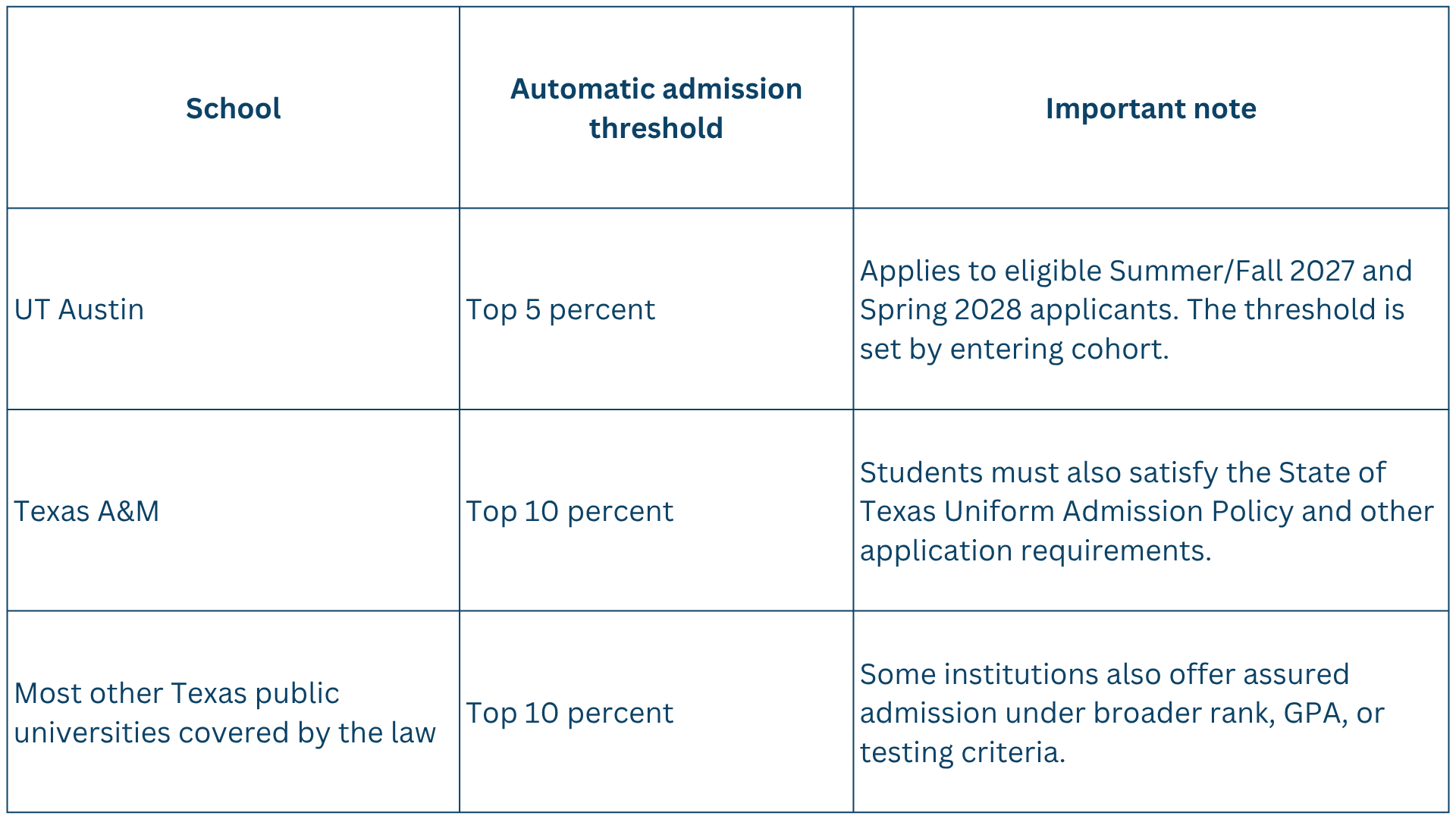
Always verify the policy for your student's exact entry term before relying on it.
UT's threshold is especially important to confirm because it can change from one entering class to another.
One point that often gets lost is that many less-selective Texas public universities offer admission well beyond the statutory top-10% guarantee.
A student outside the top 10 percent may still have excellent in-state public options.
Automatic admission is the floor required by state policy at many institutions. It is not necessarily the university's entire admission policy.
Does Automatic Admission Guarantee Your Major?
No.
This is the most consequential distinction in this article.
Automatic admission can guarantee that your student gets into the university.
It does not necessarily guarantee admission to the college, school, or major your student selected.
At UT Austin
UT explicitly says that applications from automatic-admission students are still reviewed to determine admission to specific colleges, schools, and majors.
An automatic-admit student is considered for the first-choice major.
If the student is not admitted to that first choice, UT says an automatic-admit applicant may be considered for the second-choice major.
That means a decision can effectively say:
Yes to UT Austin. No to the program you intended to study.
The issue becomes particularly important for high-demand programs.
Computer science, engineering, business, nursing, and other capacity-constrained programs attract far more qualified students than they can enroll.
Being in the top 5 percent does not remove that competition.
UT's holistic review for admission and major placement can consider factors including:
- Class rank
- Strength of academic preparation
- SAT or ACT scores
- Achievements and awards
- Activities, work, and service
- Essays
- Recommendations, if submitted
- The competitiveness of the requested major
UT also currently requires freshman applicants to submit an official SAT or ACT score.
So a student can absolutely qualify for automatic admission to UT Austin without receiving the academic program that originally made UT attractive.
At Texas A&M
Texas A&M also guarantees university admission to eligible top-10% Texas students, but certain programs have additional processes.
Engineering is the clearest example.
All applicants to the College of Engineering—including top-10% automatic admits—are reviewed for placement into General Engineering.
Most students who begin in General Engineering later enter a specific engineering major through Texas A&M's Entry to a Major, or ETAM, process.
The practical lesson is the same at both universities:
Do not confuse admission to the institution with guaranteed access to a particular academic program.
Can Your Student Just Switch Majors Later?
Sometimes.
But this is one of the riskiest assumptions a family can build a college plan around.
The strategy usually sounds like this:
Take the admission offer.
Enroll in another major.
Get good grades freshman year.
Transfer into computer science, engineering, business, or nursing later.
The problem is that internal transfer into high-demand majors is often competitive and capacity limited.
At UT Austin, the university explicitly describes the internal-transfer process as highly competitive for certain colleges and schools.
UT Computer Science goes even further: it warns students not to enter UT in another major assuming they will later transfer into computer science. The department describes that internal-transfer process as extremely competitive and says there is no guarantee of admission.
Cockrell Engineering also states that internal transfer is competitive and based on space availability.
The School of Nursing describes its internal-transfer process the same way.
Some students successfully make these switches.
But your college strategy should not depend on being one of them.
If your student wants a specific high-demand major, ask this question:
Would they still attend this university if they never got into that major?
If the answer is no, treat major admission—not university admission—as the relevant outcome when building the college list.
What Do You Have to Do Besides Rank in the Top Percentage?
The word automatic can be misleading.
There is still an application to complete correctly.
Meet the State of Texas Uniform Admission Policy
Automatic-admission eligibility includes more than class rank.
Texas law includes curriculum requirements under the state's Uniform Admission Policy, with alternate ways of satisfying those requirements in certain circumstances.
Do not assume that a high class rank alone completes the statutory requirements.
Meet the University's Own Application Requirements
For current Summer/Fall 2027 applicants, UT Austin has:
- October 15: Early Action application deadline
- October 22: Early Action supplemental-material deadline
- December 1: Regular application deadline
- December 10: Regular supplemental-material deadline
UT currently requires freshman applicants to send an official SAT or ACT score directly from the testing agency.
Texas A&M College Station currently has:
- December 1: Fall freshman application deadline
- December 15: Deadline for additional required and optional documents
Texas A&M remains test optional for general freshman admission, although test scores can still be considered when submitted and can matter in certain statutory situations.
Dates change.
Always confirm the deadlines for the exact admission cycle in which your student is applying.
Make Sure Rank Is Properly Documented
UT asks Texas high school transcripts to report class rank numerically—for example, 15 out of 500.
Texas A&M requires top-10% students to report the rank in its Self-reported Transcript and Academic Record System and provide an official transcript verifying the numeric ranking.
Do not assume the university will fix missing documentation after a deadline.
Check the application portal after submission and make sure the file is complete.
Understand What Happens If Your High School Does Not Rank
Some Texas high schools do not publish traditional class ranks.
UT asks applicants from non-ranking high schools to provide additional school information, including the school's ranking policy, school profile, and GPA or grade distribution.
Texas A&M states that it assigns a rank to students from non-ranking high schools for its review process.
But families should not assume that an internally assigned admissions rank automatically creates eligibility for the statutory Top 10 Percent guarantee.
If your student's high school does not report rank, talk with the counselor early and confirm directly with the university how automatic-admission eligibility will be established.
Do that during junior year, not in November of senior year.
Take the Essays and Short Answers Seriously
Automatic admission does not make the rest of the application meaningless.
At UT Austin, holistic review of the application is used for major selection even when admission to the university itself is automatic.
UT's required short answers include a question about why the student wants the first-choice major.
Texas A&M also requires an essay and several short responses, including questions about the student's intended major and reasons for choosing Texas A&M.
Honors programs and scholarship processes may also consider additional parts of the student's record.
The university admission may be automatic.
Many of the things your student wants inside the university are not.
What About Homeschooled Students?
This changed recently, and Texas families need to be careful with older information online.
In 2025, Texas amended the law governing how students who complete a nontraditional secondary education—including homeschool students—are assigned a rank for automatic-admission purposes.
The result is that qualifying test thresholds can differ by university and admission cycle.
For Spring 2027, Summer/Fall 2027, and Spring 2028, UT Austin states that eligible nontraditional-school applicants will qualify for automatic admission with:
- 1570 SAT, or
- 36 ACT
For Texas A&M applicants beginning Fall 2027, the scores used to assign a top-10% ranking to Texas residents completing nontraditional schooling are:
-1290 SAT, or
- 27 ACT
Those numbers are dramatically different because UT and A&M are working from different automatic-admission percentiles and institutional applicant data.
Do not use an old article, sibling's experience, or statewide rule of thumb for a homeschooled applicant.
Check the university's current automatic-admission page for the student's exact entry term.
What If Your Student Misses the UT Top-5% Cutoff?
Missing the top 5 percent does not mean your student cannot be admitted to UT Austin.
It means the guarantee is gone.
Texas residents outside the automatic-admission group can still be admitted through UT's individualized holistic review.
UT says that review considers factors including:
- Class rank
- Academic rigor
- SAT or ACT scores
- Achievements
- Activities
- Essays
- Recommendations
- The competitiveness of the requested major
A student ranked at 6, 7, or 8 percent at a highly rigorous high school can certainly apply.
But do not turn that into an admission probability based on rank alone.
Once a student is outside automatic admission, UT Austin should be evaluated as a highly competitive holistic admission rather than treated as a likely school simply because the student is close to the cutoff.
What Is CAP?
UT also offers alternative pathways to some Texas students who are not admitted directly.
The best known is the Coordinated Admission Program, or CAP.
Students participating in CAP spend freshman year at another participating UT System institution.
To maintain the guarantee, students must complete the CAP requirements, including at least 30 eligible credit hours, a minimum 3.2 cumulative GPA, and specified coursework.
Students who successfully complete CAP are guaranteed admission to UT Austin's College of Liberal Arts.
Notice what that does not say.
It does not guarantee every Liberal Arts major.
And it does not guarantee business, engineering, computer science, or another college outside Liberal Arts.
CAP students may compete for admission to majors outside the College of Liberal Arts, subject to the program's restrictions. UT currently excludes the School of Architecture and School of Nursing from those outside-Liberal-Arts CAP options.
CAP can be an excellent pathway for a student who genuinely wants a Liberal Arts program at UT.
It should not be treated as a guaranteed back door into McCombs, Cockrell, or Computer Science.
What About PACE?
UT has also operated the Path to Admission Through Co-Enrollment, or PACE, in which students took courses at both Austin Community College and UT Austin before transitioning fully to UT.
But this is exactly why families should verify alternative-admission programs every year.
UT states that PACE was not offered to Fall 2026 applicants.
Do not build a Fall 2027 or later college strategy around PACE unless UT confirms that the program is being offered for that cycle or specifically offers the pathway to your student.
What If Your Student Misses the Texas A&M Top-10% Cutoff?
Texas A&M reviews Texas applicants outside the automatic-admission group holistically.
That review includes both academic and nonacademic factors.
Academic factors include coursework, grades, rigor, GPA, and class rank.
Nonacademic factors can include extracurricular activities, community service, leadership, employment, summer activities, opportunities, challenges, and hardships.
One statistic families should not use carelessly is Texas A&M's overall acceptance rate.
For Fall 2025, Texas A&M reported 62,967 first-year applicants and 32,531 admits—an overall rate of about 52 percent.
But that number includes thousands of Texas students whose admission was guaranteed through the Top 10 Percent Rule.
A Texas student outside the top 10 percent is not competing under the same admission conditions as an automatic admit.
For that reason, the overall university acceptance rate is not a reliable measure of a non-auto-admit Texas student's admission chances.
Do not label Texas A&M a “target” simply because its overall admit rate is above 50 percent.
Evaluate the student's profile, intended major, rank, academic rigor, and the competitiveness of the holistic-review pool.
Why Automatic Admission Does Not Replace a Balanced College List
Here is the argument we make to Texas families who arrive certain that UT or A&M is already handled.
A Guaranteed Admission Is Not a Guaranteed Major
This is the most important reason.
If your child wants computer science and receives admission to the university but not computer science, the admission may not solve the problem you were trying to solve.
Build the list around the student's actual academic goal.
A Guaranteed Admission Is Not a Guaranteed Price
Automatic admission itself carries no scholarship award.
UT and Texas A&M both offer financial aid and scholarships, but families should not assume that automatic admission will produce enough merit money to make the university affordable.
If merit aid matters, deliberately include colleges where your student's academic profile makes them particularly competitive for institutional scholarships.
Then compare net price, not sticker price.
In some cases, an out-of-state public or private university with substantial merit aid can cost the same as—or less than—an in-state option.
A Guaranteed Admission Is Not Automatically a Good Fit
UT Austin is a huge urban research university.
Texas A&M is an enormous university with a distinctive culture, traditions, and college-town environment.
Those are excellent fits for some students.
They are poor fits for others.
Admission is evidence that the student can attend.
It is not evidence that the student should.
One Acceptance Is Not a Choice
The purpose of a balanced college list is not simply to manufacture acceptances.
It is to arrive in the spring with several realistic options that the student would genuinely be happy to attend.
Those offers allow the family to compare:
- Academic programs
- Major access
- Honors opportunities
- Campus fit
- Financial aid
- Merit scholarships
- Net cost
A student holding only one guaranteed university admission does not have much to compare.
Under our framework, most students should have multiple likely and target schools, including at least three genuine likelies.
Automatic admission can fill one of those likely slots at the university level.
But if the student's desired major is not guaranteed—or the school may not be affordable—it does not eliminate the need for other realistic options.
The practical version for a Texas family is simple:
Apply to UT or A&M if the school fits. Apply seriously for the competitive major if that is the goal. Then build the rest of the list as though that major may not come through.
Include colleges where the student has direct access to the intended program.
Include schools where merit money is realistic if cost matters.
And make sure there are several places on the list where admission, academic fit, lifestyle fit, and affordability can all work at the same time.
That is what makes the list balanced.
FAQs About Texas Automatic Admission
What is the Texas Top 10 Percent Rule?
Texas law provides automatic admission to eligible students who graduate in the top 10 percent of their Texas high school class at public universities covered by the statute, provided they meet the state's other automatic-admission requirements.
UT Austin operates under a special exception and currently uses a smaller percentage.
Is UT Austin still top 6 percent?
No.
For Summer/Fall 2027 and Spring 2028 applicants, UT Austin's automatic-admission threshold is the top 5 percent of the high school class.
The threshold was 6 percent for several earlier admission cycles and dropped to 5 percent beginning with Summer/Fall 2026.
Families should verify the cutoff for their student's exact entering class because UT sets it by admission cycle.
Does top 5 percent guarantee admission to UT Austin?
For an eligible Texas student who satisfies the other statutory and application requirements, top-5% status qualifies the student for automatic admission to UT Austin for the currently announced admission cycles.
It does not guarantee the student's first-choice major.
Does automatic admission guarantee your major at UT Austin?
No.
UT reviews automatic-admission applicants separately for placement into colleges, schools, and majors.
A student can therefore qualify for automatic admission to UT Austin without being admitted to the first-choice academic program.
Does being in the top 10 percent guarantee Texas A&M?
Eligible Texas residents in the top 10 percent who satisfy the State of Texas Uniform Admission Policy and complete the application requirements qualify for automatic admission to Texas A&M.
However, admission to the university does not necessarily guarantee access to every academic program.
Engineering applicants, for example, undergo a separate review for placement into General Engineering.
Does top 10 percent guarantee engineering at Texas A&M?
No.
Texas A&M states that all applicants to the College of Engineering—including students who qualify for top-10% automatic admission—are reviewed for placement into General Engineering.
Automatic admission to Texas A&M and engineering placement are therefore separate questions.
Can I get into UT Austin if I am not in the top 5 percent?
Yes.
Texas residents outside the automatic-admission group can be admitted through holistic review.
UT considers the student's broader academic and personal record, including class rank, academic rigor, test scores, achievements, activities, essays, and the competitiveness of the requested major.
Admission is simply no longer guaranteed.
Is Texas A&M a target if its acceptance rate is above 50 percent?
Not necessarily.
Texas A&M's overall acceptance rate includes Texas students who receive automatic admission through the Top 10 Percent Rule.
For a Texas applicant outside the top 10 percent, the overall admit rate is therefore not a reliable estimate of that student's individual chances.
The relevant question is how competitive the student will be in A&M's holistic-review process and for the intended major.
Can my student enter UT in another major and transfer into computer science later?
It is possible to apply for internal transfer, but it is a risky strategy.
UT Computer Science describes internal transfer as extremely competitive and explicitly warns students not to enroll in another major assuming they will later switch into computer science.
If your student would not want to remain at UT without computer science, do not build the college plan around an internal transfer.
Does CAP guarantee admission to UT Austin?
Successful completion of all CAP requirements guarantees admission to UT Austin's College of Liberal Arts.
It does not guarantee every Liberal Arts major, and it does not automatically guarantee admission to competitive programs outside Liberal Arts.
Students seeking other colleges or majors may have to compete through transfer admission.
What GPA do you need for UT CAP?
CAP students currently need a minimum 3.2 cumulative GPA, at least 30 eligible credit hours, and completion of required coursework, including a mathematics course beyond College Algebra.
Students should review the current CAP agreement because all requirements must be completed to preserve the guarantee.
Is PACE still available at UT Austin?
UT's current admissions site states that PACE was not offered for Fall 2026 applicants.
Families applying for Fall 2027 or later should not assume the pathway exists unless UT announces it for that admission cycle or offers it directly to the student.
Do automatic-admit students still need to write UT essays?
Yes.
UT requires freshman applicants to submit an essay and required short answers.
For an automatic-admission student, those materials may not determine whether the university-level admission guarantee applies, but the application is still reviewed for major placement, and honors or scholarship opportunities may involve additional review.
Do UT automatic-admission students still need SAT or ACT scores?
Yes under the current freshman policy.
UT Austin currently requires freshman applicants to submit an official SAT or ACT score from the testing agency, including students who qualify for automatic admission.
Is Texas A&M test optional?
Yes for general freshman admission under the current policy.
Texas A&M says freshman applicants are not required to submit SAT or ACT scores and will not be disadvantaged for not doing so.
Separate statutory rules can still make test scores relevant in special situations, including the current automatic-admission process for students completing nontraditional secondary education.
How does automatic admission work for homeschool students in Texas?
Texas changed this process in 2025.
Students completing nontraditional secondary education can be assigned a class-rank equivalent using standardized test performance.
The threshold is institution- and cycle-specific.
For Spring 2027, Summer/Fall 2027, and Spring 2028, UT Austin currently lists 1570 SAT or 36 ACT for automatic admission of eligible nontraditional-school applicants.
Beginning with Fall 2027, Texas A&M lists 1290 SAT or 27 ACT as the scores used to assign a top-10% rank to eligible Texas residents completing nontraditional schooling.
Because these numbers can change, always verify the requirement for the student's exact admission cycle.
Building a list around a competitive major, in Texas or out of state, is one of the trickier versions of this problem, and it is worth getting right before senior fall. Book here to work through it with one of our advisors.
We're also committed to supporting all students with free resources like this article. Join our community and receive powerful tips you can apply today as you build your list and prepare your applications. From our free videos to AskAnji, our carefully curated and trained proprietary AI assistant available 24/7, we've got you covered.
Ready for the full process? Start with our guide to how to build a balanced college list.