Small College vs Large University: How Size Shapes Four Years
Aug 31, 2026

Ask a seventeen-year-old how big they want their college to be and you will usually get a version of the same answer. Bigger. More students means more clubs, more majors, more research, more people to meet. Why would you choose less?
It is a reasonable assumption. It is also, for a lot of students, wrong in the specific way that matters.
Opportunity at a college is not a function of how many opportunities exist. It is a function of how many your student can actually reach. Those are different numbers, and the gap between them is where the real decision lives.
This is one of the preference criteria we work through before any school names enter the conversation, which is the sequence we lay out in our guide to how to build a balanced college list. Here is how to think about size properly.
On this page
- The short answer
- What counts as small, medium, and large
- Pros and cons of a small college
- What actually predicts success after college
- Who teaches your introductory classes
- Liberal arts college vs university
- Does campus setting matter more than size
- Getting a small college experience at a large university
- How to decide
- FAQs
Small College vs Large University: The Short Answer
1. More students does not mean more access. A university with 40,000 students has more research labs than a college with 2,000. It also has more students competing for spots in them.
2. The college experiences most strongly linked to later workplace engagement and well-being depend on access, not simply size. Close relationships with professors and mentors, long-term projects, internships, and meaningful involvement in campus organizations all require a student to be able to reach the opportunities a college offers.
3. At many large universities, graduate students play a significant role in introductory courses. They may lead discussion sections and labs, grade work, hold office hours, and sometimes teach courses independently. That is not necessarily bad, but it is something families should understand before enrolling.
4. For this guide, we define small as under 4,000 undergraduates, medium as 4,000 to 8,000, large as 8,000 to 15,000, and very large as anything above that. There is no universal higher-education standard for these categories.
5. Campus setting often matters more than headcount. A 6,000-student school in Manhattan and a 6,000-student school in rural Vermont are not remotely the same experience.
6. Honors colleges can sometimes give you both. A strong honors program may offer a smaller cohort, small classes, dedicated advising, and greater faculty access inside a much larger university.
7. Merit money has more to do with enrollment strategy than college size. Colleges often use merit scholarships to attract students they especially want to enroll, and that happens at institutions of many different sizes. The most selective small colleges, including Williams, Amherst, and Pomona, award need-based aid rather than merit scholarships. In practice, substantial merit offers are often more likely at a student's target and likely schools than at their reaches, although every college sets its own policy.
8. Rank tells you much less about a student's future than most families assume. Research on graduates' workplace engagement and well-being suggests that what students experience in college can matter more than whether they attended a particular type of institution. Size is one factor that can shape how easy those experiences are to access.
What Counts as a Small College, Medium, or Large University?
The categories are not standardized across the industry, so here is how we define them, counting undergraduates.
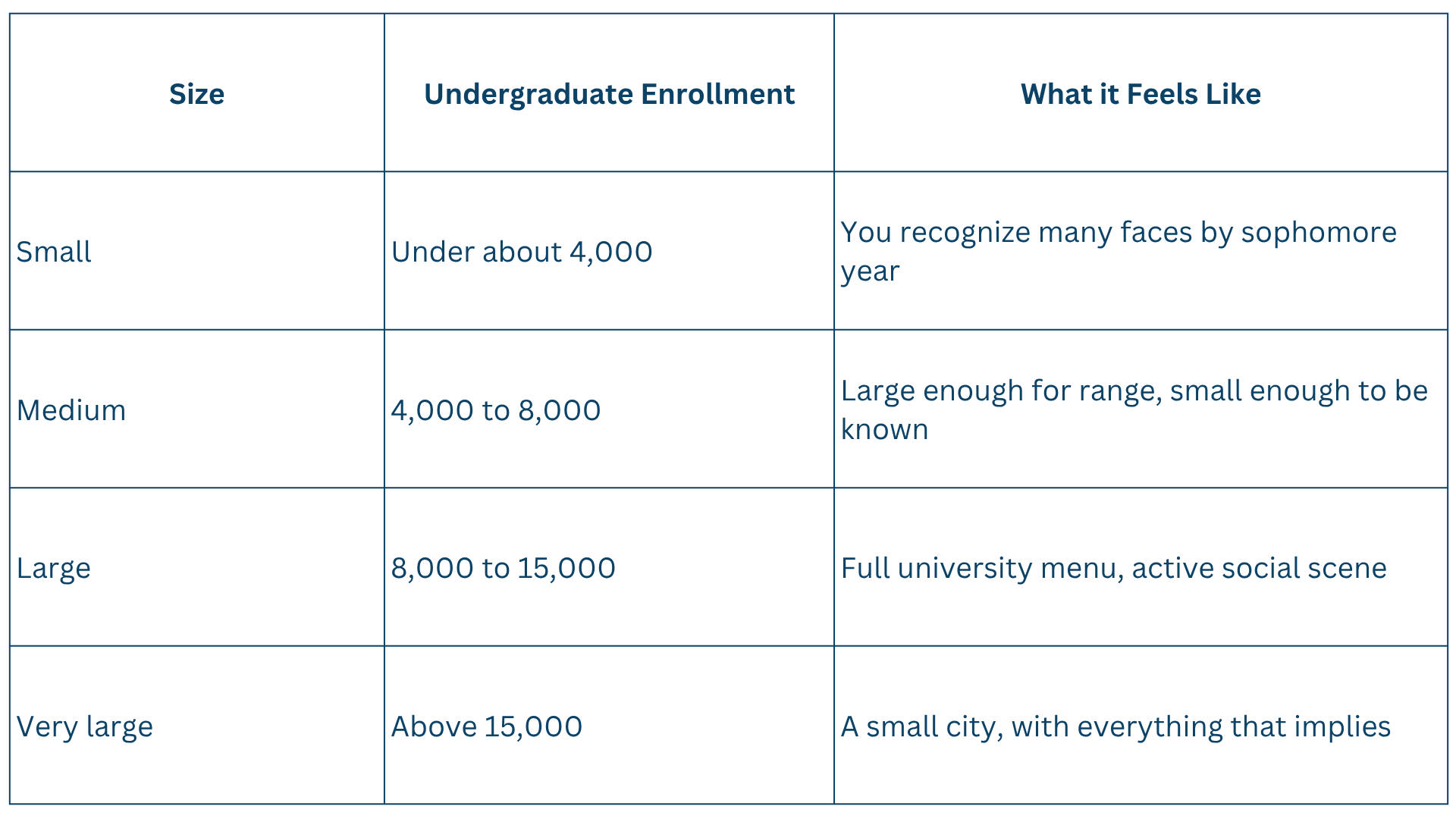
One practical note if you are filtering on College Navigator or a similar tool: set your enrollment range generously. These filters are literal, and a school that misses your cutoff by 400 students disappears from your results even if it is otherwise perfect.
What Are the Pros and Cons of a Small College?
Here is the honest version, in both directions.
What small colleges tend to do well
Access to professors is the big one, and it compounds. Your student asks a question after class, gets invited to office hours, ends up on a research project, and has a recommender who can write two specific pages about them. That chain starts with being visible.
Teaching tends to be more personal. Smaller classes can mean more discussion, more writing with feedback, and fewer courses where a student can disappear into the back row.
Leadership can arrive earlier. In a club of thirty, a sophomore may have a realistic path to running something. In a club of three hundred, that same student may spend longer working their way up.
Many small colleges compete hard for students, and that competition can show up in the aid offer. Check school by school, though. The most selective small colleges have little need to use merit scholarships as a recruiting tool and often award institutional aid based on financial need instead.
What small colleges genuinely give up
Usually fewer majors and fewer faculty or course options within highly specialized subfields. If your student wants a niche area, check whether the department has anyone actually teaching it, not just whether the major exists.
Fewer course offerings each semester, which can create scheduling conflicts, particularly for double majors.
Less anonymity. Some students find this warm. Others find it limiting, and that is a legitimate preference rather than a flaw.
A smaller social pool, and a smaller alumni network in raw numbers, though not necessarily in willingness to help.
Fewer big-time athletics programs and less of the campus culture that comes with them.
The right way to use this list is not to score it. It is to notice which two or three lines your child reacts to strongly, in either direction. Those are the ones that will actually shape the four years.
What Actually Predicts Success After College?
This is the part families rarely have data on, and it reframes the whole size question.
Gallup and Purdue surveyed more than 30,000 college graduates about their careers and their lives. One of the major findings was that broad characteristics of the institution they attended — public or private, highly selective or less selective — were much less strongly related to later workplace engagement and well-being than what students actually experienced while they were in college.
Six experiences stood out.
Three were about feeling supported:
- A professor who made you excited about learning
- Professors who cared about you as a person
- A mentor who encouraged you to pursue your goals
Three were about doing meaningful work:
- An internship or job where you applied what you were learning
- A project that took a semester or more to finish
- Serious involvement in student organizations
The differences were substantial. Graduates who reported all three of the supportive experiences were more than twice as likely to be engaged in their work later on as graduates who reported none of them.
A later Strada-Gallup study went directly at the size question. Among current college students, those attending institutions with fewer than 5,000 students were considerably more likely to report supportive relationships with faculty.
Forty-five percent of students at institutions with fewer than 5,000 students strongly agreed that their professors cared about them as people, compared with 24 percent at larger institutions. Thirty-four percent said they had a mentor who encouraged them to pursue their goals and dreams, compared with 23 percent at larger institutions.
That does not prove that a small college will be better for your student. It does tell us that size can affect the likelihood of forming the kinds of relationships that matter.
Now read the six experiences again with size in mind.
Every one is ultimately about access, not just availability.
A university with 40,000 students has more professors, more research labs, more internships, and more clubs. It also has thousands more students trying to reach those professors, enter those labs, land those internships, and lead those organizations.
A smaller college may offer fewer opportunities in raw numbers but make some of them easier for an undergraduate to reach.
This is not an argument that small is better.
It is an argument that the usual question is the wrong one.
Do not ask which school has more.
Ask where your student is actually likely to get mentored, get into a lab, land the internship, build relationships with professors, and end up running something.
Who Teaches Your Introductory Classes?
At large research universities, who actually teaches an introductory course can vary.
A professor may deliver the main lecture while graduate instructors lead the smaller discussion or laboratory sections. Graduate students may also grade assignments, hold office hours, or provide much of the direct student contact in a course. In some departments, advanced graduate students teach introductory courses independently.
This is not automatically bad.
Some graduate instructors are excellent teachers, and a graduate student leading a 20-person discussion section may be far more accessible than the senior professor giving the 400-person lecture.
But it should be a fact you know going in rather than one your child discovers in the third week of freshman year.
Two published measures can help, although neither tells you exactly who will teach your student's classes.
Student-to-faculty ratio. This provides a rough measure of instructional staffing relative to enrollment. One limitation is worth understanding: graduate teaching assistants are not counted as faculty in the Common Data Set calculation.
Class-size distribution. The Common Data Set reports how many undergraduate class sections fall into different size ranges. That can be more useful than a simple campus-wide average.
For your student's intended major, go one step further. Look at the actual introductory course schedule. How large are the classes? Who is listed as the instructor? Are there separate discussion sections or labs? Who leads them?
Then ask your student the question that actually matters:
How do you do in a room where nobody would notice if you did not show up?
Some students thrive with that anonymity and use it well. Others need discussion, feedback, and a professor who knows their name.
Neither answer is better. Getting it wrong is expensive.
While you are pulling numbers, check the first-year retention rate too. It is not a satisfaction score, but an unusually low retention rate can be a useful signal to investigate. It tells you what share of first-time students returned for year two. It does not tell you why they stayed or left.
What Is the Difference Between a Liberal Arts College and a University?
Size is part of it, but the structural difference is the point.
A liberal arts college is usually small, focused heavily on undergraduate education, and built around breadth across disciplines before depth in one. Faculty roles generally place greater emphasis on undergraduate teaching, although research, scholarship, and service still matter for hiring and promotion.
There are often few or no graduate programs. With fewer graduate students competing for faculty attention, undergraduates may have more direct access to faculty research opportunities.
A university is typically larger and organized around multiple schools and colleges, with graduate and professional programs alongside undergraduate programs.
At research universities, faculty are frequently evaluated heavily on research output as well as teaching. That produces genuine advantages, including access to major laboratories, highly specialized faculty, graduate-level infrastructure, and work at the frontier of a field.
It also creates one recurring tradeoff: undergraduate teaching is only one of several demands on a professor's time.
Two things families often get wrong here.
First, "liberal arts" describes the educational approach, not the subject matter.
Plenty of liberal arts colleges, including Carleton College, are exceptionally strong in the sciences. In fact, liberal arts colleges are disproportionately represented among institutions whose graduates later earn research doctorates.
Second, the distinction is not clean.
Many mid-sized universities teach in a recognizably liberal arts way, and some small colleges are highly pre-professional.
Judge the individual school, not the category.
Does Campus Setting Matter More Than Size?
Often, yes.
Official college databases generally classify institutions using categories such as city, suburb, town, and rural. For campus-fit conversations, however, we find it more useful to think about the actual student experience.
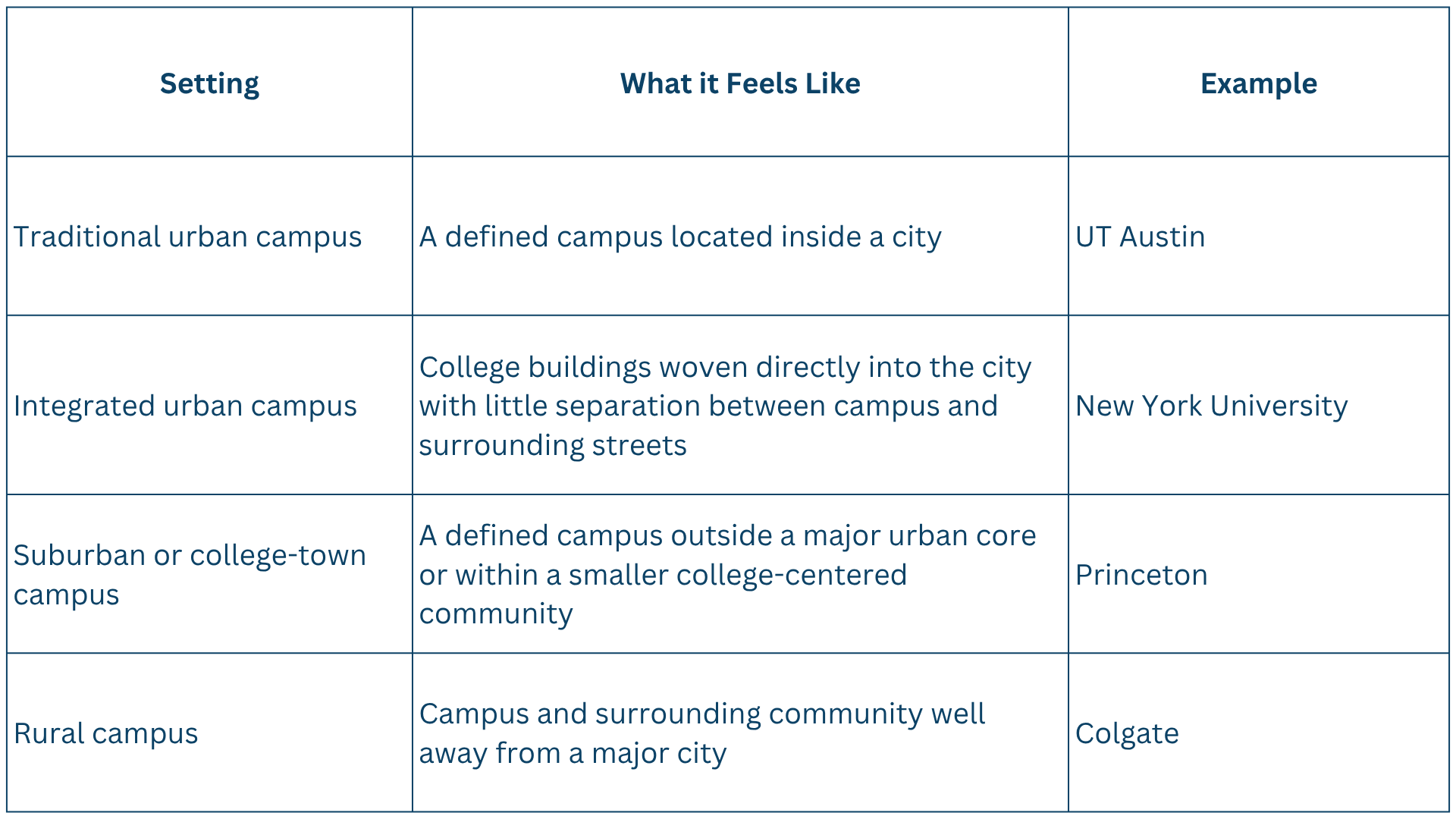
Setting and size interact.
A small school in a rural setting can be a genuinely enclosed world, which some students find ideal and others find limiting by October of sophomore year.
A small school in the middle of a major city may barely feel small socially because the city supplies much of the range the campus does not.
Many students are drawn to big cities and may overestimate how much time they will actually spend exploring them. Between coursework, jobs, clubs, friendships, and campus events, the week can fill up quickly, and the museums stay unvisited.
Two other setting-driven factors deserve attention: safety and housing.
Safety can vary significantly by campus and surrounding neighborhood, so evaluate the specific school rather than assuming that urban, suburban, or rural automatically means safer.
Housing guarantees also vary widely. Some colleges guarantee housing for four years. Others guarantee it only for first-year students. At commuter-heavy universities, a large share of students may live off campus.
That can change the social experience more than the enrollment number does.
Can You Get a Small College Experience at a Large University?
Sometimes, and this is the option many families overlook.
Honors colleges. A well-run honors college can function like a small college inside a large university.
Depending on the program, students may get small seminar classes, a defined cohort, priority registration, dedicated advising, honors housing, or greater faculty access, wrapped around the course catalog, research infrastructure, student organizations, and athletics of a much larger institution.
At some universities, honors admission and substantial merit scholarships overlap because both are tools for recruiting high-achieving students. But the two are not automatically linked, so check each university's policies separately.
One student we worked with, a homeschooled debater with strong grades and a 1460 SAT, was admitted to the honors college at a large university with $96,000 in scholarships. The honors program gave him access to a smaller academic community while the university gave him the resources and range he wanted.
Residential colleges and living-learning communities. Some very large universities divide undergraduates into smaller residential communities with their own programming, traditions, advising, classes, or shared academic interests.
These can create a much smaller social and academic home inside a very large institution.
Consortia, in the other direction. Several small colleges belong to groups that allow students to share courses, resources, and social life across campuses. This can widen the academic and social range without changing the size of your student's home institution.
Bryn Mawr and Haverford are a familiar example.
Also look at the Claremont Colleges in California, including Pomona and Scripps, and the Five College Consortium in Massachusetts, which includes Amherst, Hampshire, Mount Holyoke, Smith, and the University of Massachusetts Amherst.
If your student wants small classes but not a small university experience — or a large range of opportunities without disappearing into a huge institution — one of these structures may solve the problem.
Ask about them during campus visits and while researching schools.
How Do You Decide What Size Is Right?
Sort size and setting the same way you would any other college criterion, before school names start driving the conversation.
Put each into one of four buckets:
Must have. Would be nice. Do not care. Absolutely not.
Then pressure-test the answer with these questions.
Where has your student done their best work so far?
Small seminar? Large lecture? Independent project? Team setting?
Recent evidence beats speculation.
Do they start conversations with adults, or wait to be approached?
A student who naturally seeks out professors can succeed in an enormous university.
A student who tends to wait may get more from an environment where professors are more likely to notice them first.
What do they want to lead?
If the answer is something specific, check whether it exists at each school and how difficult it is for a younger student to become meaningfully involved.
Remember, though, that students can also start their own clubs and organizations.
How much structure do they need?
Large universities can give students tremendous freedom.
That is exactly the problem for some eighteen-year-olds and exactly the best environment for others.
Would they be happy on this campus on a Wednesday in February?
Not on an admitted-student day in April.
On an ordinary bad-weather Wednesday when there is no tour guide, no free food, and nothing special happening.
That is the campus they are actually choosing.
Record the answers in your tracker as you research, one row per school. Ratings written while the tab is still open are worth far more than ratings reconstructed from memory months later.
Then, most importantly, apply across the range.
If your student is not already certain about size, include some smaller and some larger colleges on the initial list. Visit both if you can, and let your student notice their own reaction.
Students are often surprised by what they like, and many know remarkably quickly once they walk a campus.
The goal is not to decide that small colleges are better than large universities, or the reverse.
It is to stop treating enrollment as a proxy for opportunity.
The better question is:
At which college is your student most likely to turn the opportunities that exist into experiences that actually shape their four years?
FAQs About Small Colleges vs Large Universities
Is a small college better than a large university?
Not necessarily. Small colleges often offer smaller classes, easier access to professors, and more opportunities to become known quickly. Large universities usually offer more majors, research facilities, student organizations, athletics, and specialized programs.
The better choice depends on how your student learns, how much structure they need, and whether they are likely to take advantage of the opportunities available to them.
What is considered a small college?
There is no universal definition. For this guide, we consider a college with fewer than about 4,000 undergraduates small.
We define 4,000 to 8,000 undergraduates as medium-sized, 8,000 to 15,000 as large, and more than 15,000 as very large.
Enrollment is only part of the experience, though. A 4,000-student college in a rural town can feel very different from a 4,000-student college in the middle of a major city.
What are the main advantages of a small college?
Small colleges often make it easier for students to build relationships with professors, participate in class, find mentors, and take on leadership roles earlier.
They may also give undergraduates greater access to research opportunities because there are fewer graduate students competing for those positions.
The tradeoff is that small colleges usually offer fewer majors, fewer specialized courses, a smaller social pool, and fewer big-time athletic programs.
What are the main advantages of a large university?
Large universities usually offer a wider range of majors, courses, research labs, student organizations, athletic programs, and campus resources.
They can be especially attractive to students who want a highly specialized academic field, major research facilities, Division I sports, or a very large social environment.
But having more opportunities does not automatically mean a student will have greater access to them. At a large university, students may need to be more proactive about seeking professors, mentors, research positions, and leadership opportunities.
Are classes always smaller at small colleges?
Usually, but not always.
Small colleges tend to have fewer very large lecture courses and often emphasize discussion-based classes. Large universities may have introductory courses with hundreds of students, particularly in popular subjects.
However, class size can vary considerably within the same institution. Before choosing a college, look at the class-size distribution and, if possible, the actual introductory courses in your student's intended major.
Do graduate students teach classes at large universities?
Sometimes.
At many research universities, professors give the main lecture while graduate teaching assistants lead smaller discussion sections or laboratories, grade assignments, or hold office hours. Advanced graduate students may also teach some courses independently.
That does not necessarily mean the teaching will be worse. The important thing is to understand who will actually teach and interact with your student, particularly during the first year or two.
Is a liberal arts college the same thing as a small college?
No.
Most liberal arts colleges are relatively small, but "liberal arts" describes an educational approach rather than an enrollment size.
Liberal arts colleges typically emphasize undergraduate education, broad study across disciplines, close faculty interaction, and smaller classes. Many are also strong in science, mathematics, economics, and other fields that families do not always associate with the term "liberal arts."
Universities, by contrast, generally include multiple undergraduate, graduate, and professional schools and often have a larger research mission.
Can a student get a small-college experience at a large university?
Yes.
Honors colleges, residential colleges, and living-learning communities can create smaller academic and social communities within large universities.
Depending on the program, students may receive smaller classes, dedicated advising, priority registration, honors housing, or greater faculty access while still having access to the research facilities, athletics, course selection, and student organizations of a large university.
Families should compare honors programs carefully because the benefits vary significantly from one university to another.
Do small colleges give more merit scholarships?
Not automatically.
Merit aid depends more on a college's enrollment strategy than its size. Some small and mid-sized colleges offer substantial merit scholarships because they are competing for strong students. Many large universities do the same.
At the other end of the spectrum, some highly selective colleges — including Williams, Amherst, and Pomona — do not award institutional merit scholarships and instead provide financial aid based on demonstrated need.
Students looking for merit aid should research each college's policy individually rather than assuming small or large schools will be more generous.
Does college size affect student success?
College size by itself does not determine whether a student will be successful.
Research has found strong relationships between later workplace engagement and experiences such as having professors who care about students, finding a mentor, completing a substantial project, participating in an internship, and becoming deeply involved in campus activities.
College size matters partly because it can affect how easy or difficult those experiences are to access.
The more useful question is not simply, "How big is the college?" It is, "How likely is my student to form relationships, become involved, and use the opportunities available there?"
Is an urban college better than a rural college?
Neither is inherently better.
An urban college may give students access to internships, employers, cultural institutions, restaurants, transportation, and life beyond campus. A rural or college-town campus may offer a more concentrated residential experience where much of students' academic and social life happens in one place.
Students should think about what they want an ordinary week to feel like, not just what sounds exciting during a campus tour.
How can my student decide what college size is right for them?
Start with how your student has actually learned and functioned best in the past.
Consider whether they prefer small discussions or large groups, whether they seek out adults or wait to be approached, how much structure they need, what they want to get involved in, and how important big-time athletics or a large social environment are to them.
If your student is unsure, do not force the decision too early. Include colleges of different sizes on the initial list and visit both smaller and larger campuses when possible.
The goal is not to find the college with the most opportunities. It is to find the environment where your student is most likely to use them.
Not sure which end of the range fits your student? That is exactly the kind of question we work through before a single school goes on the list. Book here to talk it through with one of our advisors.
We're also committed to supporting all students with free resources like this article. Join our community and receive powerful tips you can apply today as you build your list and prepare your applications. From our free videos to AskAnji, our carefully curated and trained proprietary AI assistant available 24/7, we've got you covered.
Ready to build the full list? Start with our guide to how to build a balanced college list.