Should You Apply Test Optional? A Decision Framework
Sep 17, 2026
For about five years, families could reasonably assume that a strong student might skip the SAT entirely and stay competitive at selective colleges.
That assumption has stopped being true, and the change happened faster than most families noticed. Six of the eight Ivy League universities require the SAT or ACT for the 2026-27 cycle. The two holdouts, Princeton and Columbia, have both announced requirements beginning with the 2027-28 cycle, which makes it all eight for the high school class of 2028. MIT, Caltech, Stanford, and Georgetown require scores. The entire Florida and Georgia public systems require them. UT Austin brought its requirement back in 2024. Auburn is phasing out test optional entirely, with every fall 2027 applicant required to submit regardless of GPA, and LSU is reinstating for its 2027 entering class. The University of Alabama is taking a middle path, requiring scores from applicants whose GPA falls below 3.0.
Meanwhile the University of California system remains test-free for now and will not look at a score even if you send one, although the system is under real pressure to reconsider.
Parents usually ask "should we go test optional" as a yes-or-no question. It isn't one. Some colleges on your student's list require scores, some ignore them, and some reward them. One answer for all of them will be wrong for a few.
Here is the framework we use.
On this page
- Should You Submit Test Scores? The Short Answer
- What Are the Four Testing Policy Categories?
- What Changed, and Why?
- Step One: Check Every School Individually
- Step Two: Should You Submit Your Score?
- Step Three: What About Merit Scholarships and Honors Colleges?
- When Should You Submit a Score That Is Not Great?
- When Should You Withhold a Decent Score?
- What Test Optional Does Not Mean
- Practical Testing Mechanics
- How This Affects Building Your List
- Frequently Asked Questions
- Ready to talk?
Should You Submit Test Scores? The Short Answer
This is a school-by-school decision, not a family policy. The same score can be an asset at one school on the list and a liability at another.
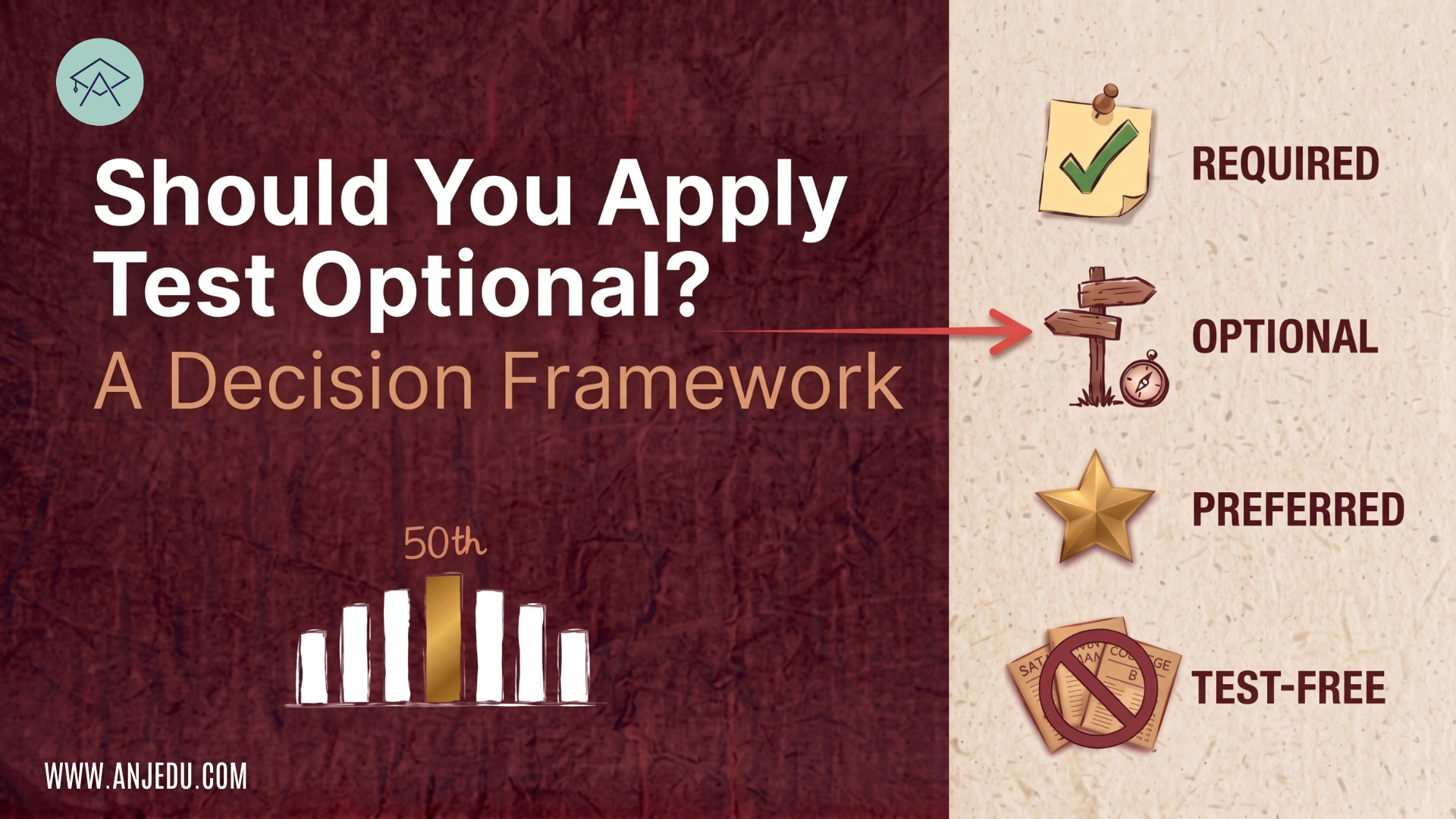
Check the category first. Required, optional, preferred, or test-free. Only one of those four leaves you a choice.
The basic rule: submit if the score sits at or above the middle of the school's range. Withhold if it sits near the bottom.
In between, it depends on what else the application needs to prove.
Merit scholarships change the calculation entirely. Many are scored separately, and many require or reward test scores even at test-optional schools.
Honors colleges frequently require scores even when the university does not.
Test-free or test-blind means never send. They will not look, and it is a waste of the fee.
Test optional does not mean test ignored. If you send it, it is read.
A below-range score at a school that requires submission makes that school a reach or a lottery, regardless of everything else in the file.
What Are the Four Testing Policy Categories?
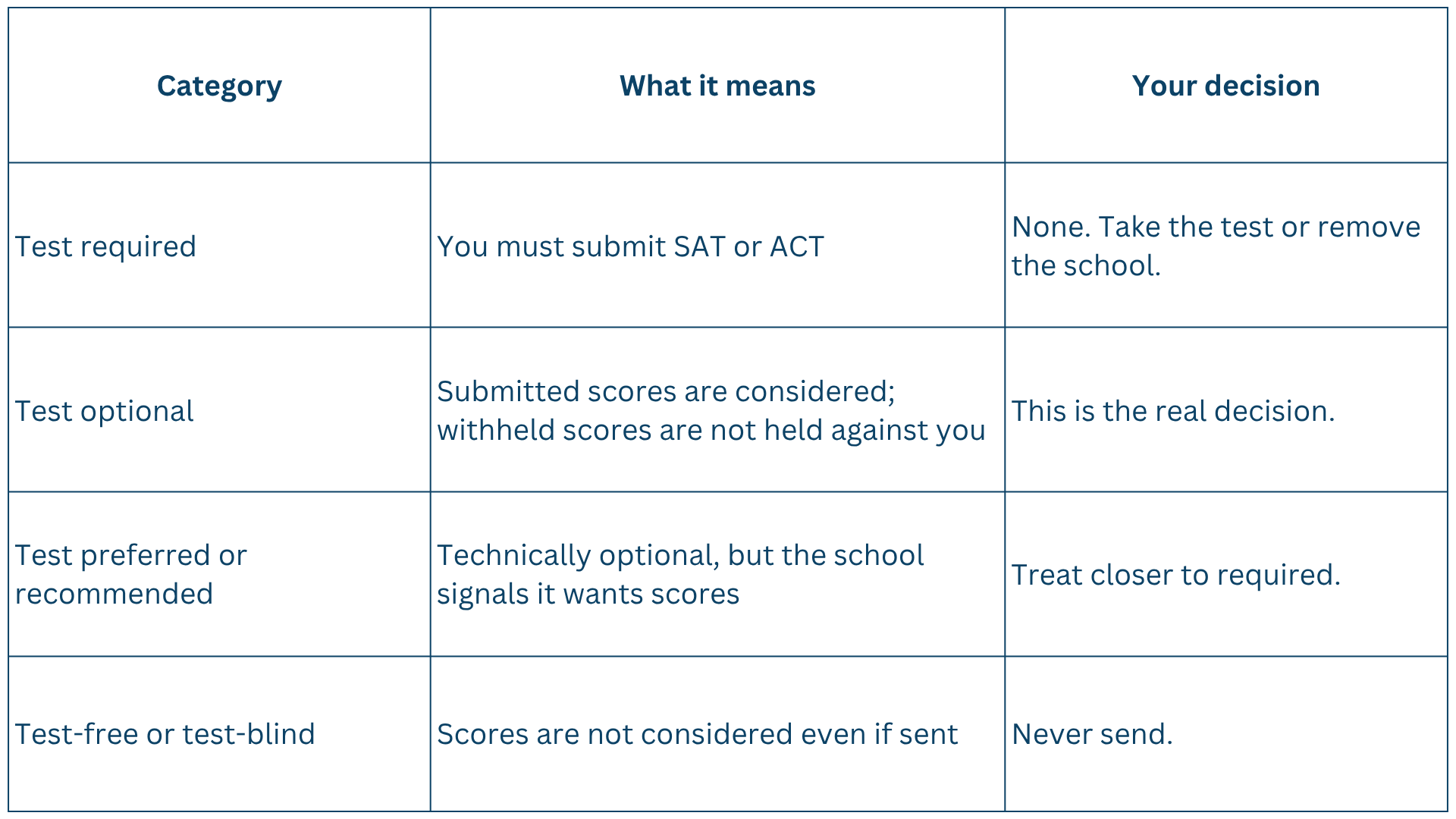
The distinction between test optional and test preferred trips up a lot of families. When a school says scores are "strongly recommended," or reports in its Common Data Set that it considers them Important, the optional label is doing less work than it appears to. Read the actual language on the admissions page rather than the label.
A fifth pattern is now common enough to watch for: conditional policies, where the requirement depends on GPA. The UNC System does not require a score from applicants with a weighted GPA of 2.8 or higher, but does below that line. The University of Alabama will require scores from applicants below a 3.0 starting with the 2027 entering class. These schools are neither test optional nor test required in the ordinary sense, and the category label on a third-party list will usually get them wrong.
Also worth knowing: some test-free schools accept scores after the admission decision for course placement only. That is not an admissions consideration and should not change your strategy.
What Changed, and Why?
Understanding the reasoning helps you predict where a specific school will land.
Colleges did not bring testing back out of nostalgia. They brought it back because their own institutional research told them scores predicted academic performance on their campuses. Princeton announced its return to required testing on October 9, 2025, stating that a review of five years of data from the test-optional period found academic performance at Princeton was stronger among students who had submitted scores than among those who had not. Columbia followed in June 2026, the last Ivy to do so, citing a multi-year faculty review that reached a similar conclusion. Dartmouth, which moved first in February 2024, published research finding that scores predicted success at Dartmouth better than high school GPA did, particularly for first-generation and lower-income applicants.
The second driver is grade inflation. Without a common benchmark, admissions offices leaned harder on GPA and on activities, and both are harder to compare across high schools.
The movement is not universal, but the holdout is under pressure. The University of California remains test-free. In a June 5, 2026 open letter, UC STEM faculty called for an SAT or ACT math requirement for applicants to STEM-intensive majors beginning with the 2027-28 cycle, citing a widening gap in mathematical preparation among incoming students. By mid-July roughly 2,400 faculty had signed, including seven of the system's nine mathematics department chairs, and more than 900 humanities and social science faculty signed a companion letter asking for the verbal reasoning component as well. UC announced a systemwide review in June, then the academic senate's admissions board withdrew its plan in July and said it was revising its timeline. The board chair has said a recommendation is expected by the end of the current academic year. Nothing has changed for applicants, and UC remains test-free while this plays out.
One more development worth knowing about: the Classic Learning Test, or CLT, is now accepted by roughly 300 to 325 colleges, including Florida's public system, the service academies, and the UNC System, which approved it as an alternative to the SAT and ACT for fall 2027 admissions. It remains a minority option, it is not accepted at most selective private universities, and it is not a substitute for the SAT or ACT at the great majority of schools.
The practical upshot: policies are moving, mostly in one direction, and a policy that was true when an older sibling applied may not be true now.
Step One: Check Every School Individually
Do this before your student spends a single hour on test prep, and do it again in the fall of senior year, because announcements land mid-cycle.
Two sources. The school's own admissions site is authoritative and current. Its Common Data Set, section C7, tells you how heavily it weighs scores relative to everything else, which is the part the admissions page will not say plainly. Section C9 gives you the actual score ranges.
Record the answer for each school in your tracker. A column for policy category, a column for whether the school superscores, and a column for whether scores are required for merit or honors consideration. Those three facts drive every decision that follows, and reconstructing them in November is miserable.
If a required-score school is on the list and your student is not going to test, that school comes off the list. That is a legitimate outcome of this step.
Step Two: Should You Submit Your Score?
For the schools that genuinely leave it optional, here is the rule we use. It has exceptions, which are covered in the two sections below.
Find the school's middle 50 percent score range, published in section C9 of its Common Data Set and usually on its admissions site as well.
At or above the middle of that range: submit. Your student's score is helping. It confirms academic readiness and it strengthens the file.
Near or below the bottom of that range: withhold. The score will not add anything the transcript does not already say, and it introduces a number that argues against admission.
Somewhere in the middle: it depends, and the deciding question is what else in the application needs support.
Three cautions about the numbers themselves. The Common Data Set reports scores for enrolled first-year students, not admitted ones, so the published range is not quite the admitted-student range and tends to sit slightly higher. In the test-optional era those figures reflect only the students who chose to submit, which skews them upward again. And a range for the university as a whole may understate what a competitive major within it actually looks like.
One more piece of honesty. If your student's score sits well below a school's range and that school requires submission, this is not a strategy problem. That school belongs in the lottery or super lottery part of your list, and it should be counted there when you check the balance.
Step Three: What About Merit Scholarships and Honors Colleges?
This is the step that most articles on this topic skip, and it frequently reverses the answer from step two.
Merit scholarships often run on separate criteria. A university can be test optional for admission while its merit program uses scores as a primary sorting mechanism, sometimes with published score-and-GPA grids that spell out award amounts. A student who withholds a score in that situation may be admitted and receive nothing.
Honors colleges frequently require or strongly favor scores, even at universities that do not require them for general admission. Honors admission is where small classes, priority registration, and often additional money live, so this matters.
Some state scholarship programs have their own score thresholds entirely independent of any college's policy. Florida's Bright Futures is the clearest example, with its own qualifying scores on the SAT, ACT, or CLT.
Automatic merit exists at a number of universities, where a defined score and GPA combination produces a guaranteed award. That is worth real money and it requires a score. These grids are republished every year and the thresholds move, so check the current one rather than the version a friend used two cycles ago.
So the question is not just "should we submit to this school." It is "should we submit to this school for admission, for merit, and for honors," and those three can have different answers. Check the merit and honors pages, not only the admissions page. If merit money is in your must-have column, this step is not optional.
When Should You Submit a Score That Is Not Great?
Several situations argue for submitting even a middling score.
The transcript needs context. Homeschooled students, students at schools that do not rank or that use unusual grading, and students whose curriculum is hard for a reader to interpret all benefit from a common benchmark.
There is a blip to offset. A rough semester reads differently next to a strong test score.
Merit or honors requires it, as above.
The school superscores and your student has strong section scores. A combined superscore can land meaningfully above any single sitting.
The school considers scores Important in its Common Data Set despite the optional label.
When Should You Withhold a Decent Score?
And the reverse.
The score sits below the school's middle range, even if it is objectively a good score. Good is relative to the applicant pool, not to the national average.
The rest of the application is stronger without it. A student with a demanding transcript, strong recommendations, and real accomplishment does not need a score that says less than the transcript already does.
The school is test-free. Nothing to weigh.
Your student's score is far above the range at a likely school and you are worried about yield. This one comes up, and the answer is usually still submit. A high score does not cause a denial by itself, and it often triggers merit money. Address the yield concern through demonstrated interest instead.
What Test Optional Does Not Mean
It does not mean scores are ignored. If you send them, they are read and weighed.
It does not mean the school is indifferent. Check C7 in the Common Data Set for what the school actually says about weight.
It does not extend to merit and honors unless the school says it does.
It does not apply uniformly within a school. Some programs, majors, and scholarship tracks have their own requirements.
It does not always apply to every applicant type. Homeschooled and international applicants sometimes face different rules.
It does not mean prep is wasted. Colleges say they are testing aptitude. What they are largely measuring is preparation, which is why prepared students score better. If your student is going to test at all, prepare properly.
Practical Testing Mechanics
Take one test, not both. Most students perform meaningfully better on the SAT or the ACT rather than equally on both, and a diagnostic can indicate which before you invest in prep. Splitting preparation across two tests usually produces two mediocre scores.
Limit sittings. Two, or at most three, with real preparation in between. More than that produces diminishing returns and a record of attempts.
Learn each school's reporting rules. Some superscore across sittings, some require every score from every sitting, and some let you send only what you choose. These vary and they matter. Record them per school.
Know what the ACT changed. Since the enhanced ACT rolled out in 2025, science is an optional section and no longer counts toward the composite, which is now the average of English, math, and reading. Students who take science receive a separate score. A handful of colleges still require or recommend it, so check before deciding to skip it. The ACT writing test remains optional and most colleges ignore it. The SAT essay no longer exists at all, having been discontinued in 2021, so there is nothing to decide there.
Do not report future sittings as though they were results. Listing a planned test date is fine and the Common App asks for it. Treating an unwritten score as part of the case for admission is not.
Consider AP scores separately. Reporting fours and fives can strengthen an application, particularly at likely and target schools.
How This Affects Building Your List
Test policy is a filtering criterion, not just an application decision.
If your student tests well, required-score schools become relatively more attractive, because a strong score is a differentiator again in a way it was not three years ago.
If your student does not test well, the list should tilt toward genuinely test-optional and test-free institutions, and you should verify the merit implications at each one before finalizing. A test-optional school that gates its scholarships on scores is not really solving the problem for you.
Either way, keep the policy column in your tracker current through the fall. The framework for the rest of the list is in our guide to how to build a balanced college list.
Frequently Asked Questions
Should I apply test optional?
Only where the school genuinely leaves it optional, and then only if the score does not help. The working rule is to submit when the score sits at or above the middle of the school's published range and withhold when it sits near or below the bottom. This is decided school by school, not once for the whole list, and it has to be checked again for merit scholarships and honors colleges, which often run on separate criteria.
What is the difference between test optional and test blind?
Test optional means the college will consider a score if you send one and will not penalize you if you do not. Test blind, also called test free, means the college will not look at a score under any circumstances, so sending one accomplishes nothing. The University of California is the largest test-free system in the country. A third category, test preferred, is technically optional but signals that the school wants scores, and it should be treated closer to required.
Do test-optional applicants get less merit aid?
Frequently, yes, though not because of a penalty. Many merit programs are evaluated separately from admission and use test scores as a primary sorting mechanism, sometimes through published score-and-GPA grids that determine award amounts. A student can be admitted test optional and receive nothing, while a classmate with a submitted score receives a substantial award. Some state scholarship programs, like Florida's Bright Futures, have their own score thresholds independent of any college's policy.
Should I submit my SAT scores or not?
Compare the score against the school's middle 50 percent range in section C9 of its Common Data Set. At or above the middle, submit. Near or below the bottom, withhold. In between, ask what else in the file needs support. Then check whether the school superscores, whether merit or honors requires a score, and whether the school marks test scores as Important in section C7 despite the optional label. Any of those can flip the answer.
Which schools require test scores for 2027?
Six Ivies require scores for the 2026-27 cycle, and Princeton and Columbia join them for 2027-28, which makes it all eight for the class of 2028. MIT, Caltech, Stanford, and Georgetown require scores. So do the Florida and Georgia public systems and UT Austin. Auburn requires scores from every fall 2027 applicant, LSU is reinstating for its 2027 entering class, and Alabama will require them below a 3.0 GPA. Verify each school on its own admissions page before you finalize a plan, because announcements land mid-cycle.
Does applying test optional hurt my chances?
At a genuinely test-optional school, a withheld score is not held against the applicant. What changes is the weight carried by everything else, because the reader has one less data point and leans harder on the transcript, the rigor of the coursework, the recommendations, and the essays. At schools where a large majority of admitted students submit scores, applying without one is not a penalty but it is a narrower path.
What counts as a good enough score to submit?
Good is relative to the school, not to the national average. A score in the 1400s is an asset at most universities in the country and a liability at a school whose middle 50 percent starts at 1500. This is why the decision has to be made school by school, and why a single family-wide policy will be wrong somewhere on the list.
Does my student need to take both the SAT and the ACT?
Almost never. Most students score meaningfully better on one than the other, and a diagnostic will usually reveal which before you spend money on prep. Splitting preparation across two tests tends to produce two mediocre scores rather than one strong one. Colleges accept either and do not prefer one over the other.
Should my student take the optional ACT science section?
It depends on the list. Since the enhanced ACT rolled out in 2025, science no longer counts toward the composite score and is reported separately. A handful of colleges still require or recommend it, and it can be useful for a student applying to STEM programs. If no school on the list asks for it, skipping it shortens the test and frees up prep time for the sections that do count.
We are homeschooling. Does test optional apply to us?
Sometimes not. Homeschooled applicants face different rules at a number of colleges, and several that are test optional for traditionally schooled students still expect scores from homeschooled ones. A score is also genuinely useful here, because it gives a reader an external benchmark when the transcript is difficult to interpret. Check each school's homeschool admissions page specifically, not just the general testing policy.
Ready to Talk?
The merit implications are where families most often leave money behind. If you want help mapping testing policy across your student's list, the Admission Strategy Session is a free call: Book here to talk it through with one of our advisors.
You can also ask AskAnji our admissions AI trained on the way we advise.
We're committed to supporting all students with free resources like this article. Join our community and receive powerful tips you can apply today as you build your list and prepare your applications. We've got you covered.
For the full process, start with our guide to How to Build a Balanced College List.