Is an Honors College Worth It? The Case for Target Schools
Sep 21, 2026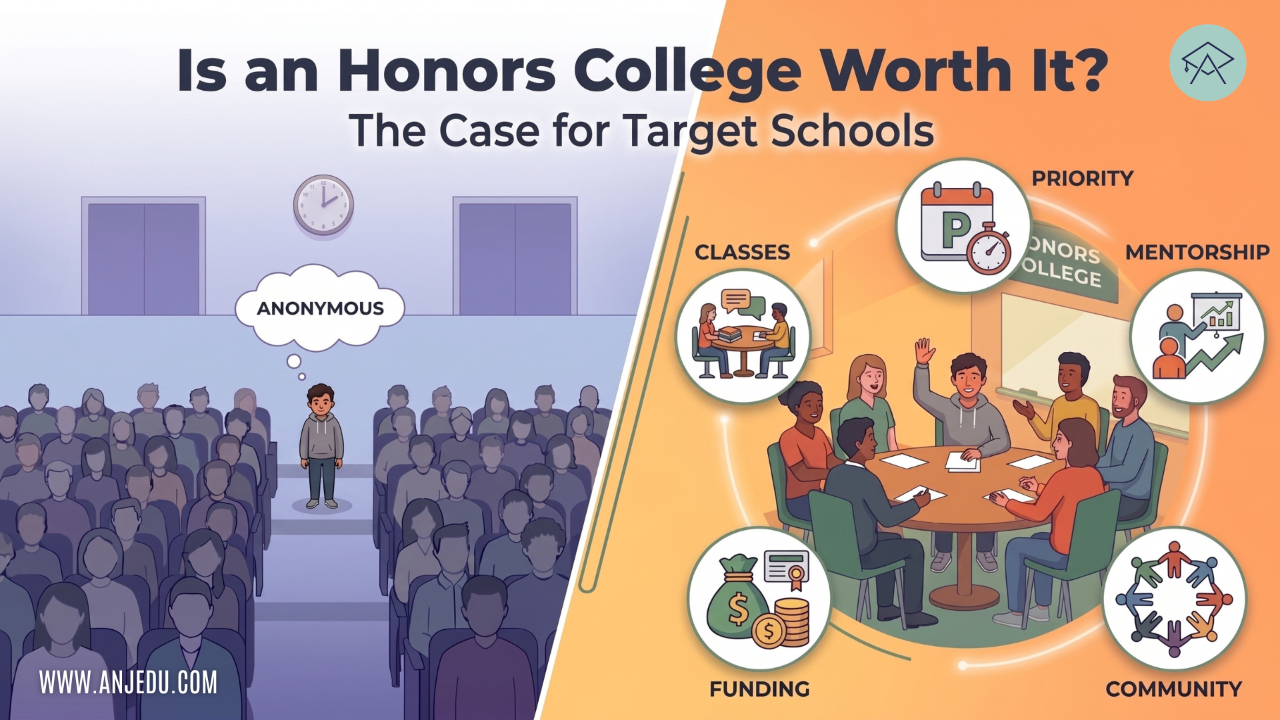
Here is a conversation we have every April.
A family is holding two envelopes. One is a denial from the school everyone in the extended family had been told about. The other is an acceptance from a university that admits more than half its applicants, with an honors college invitation and a scholarship attached.
The student is deflated. A parent is quietly doing math and not saying anything. And nobody in the room is treating the second envelope as what it actually is, which is frequently the better outcome, especially when planning a costly graduate path like medical school.
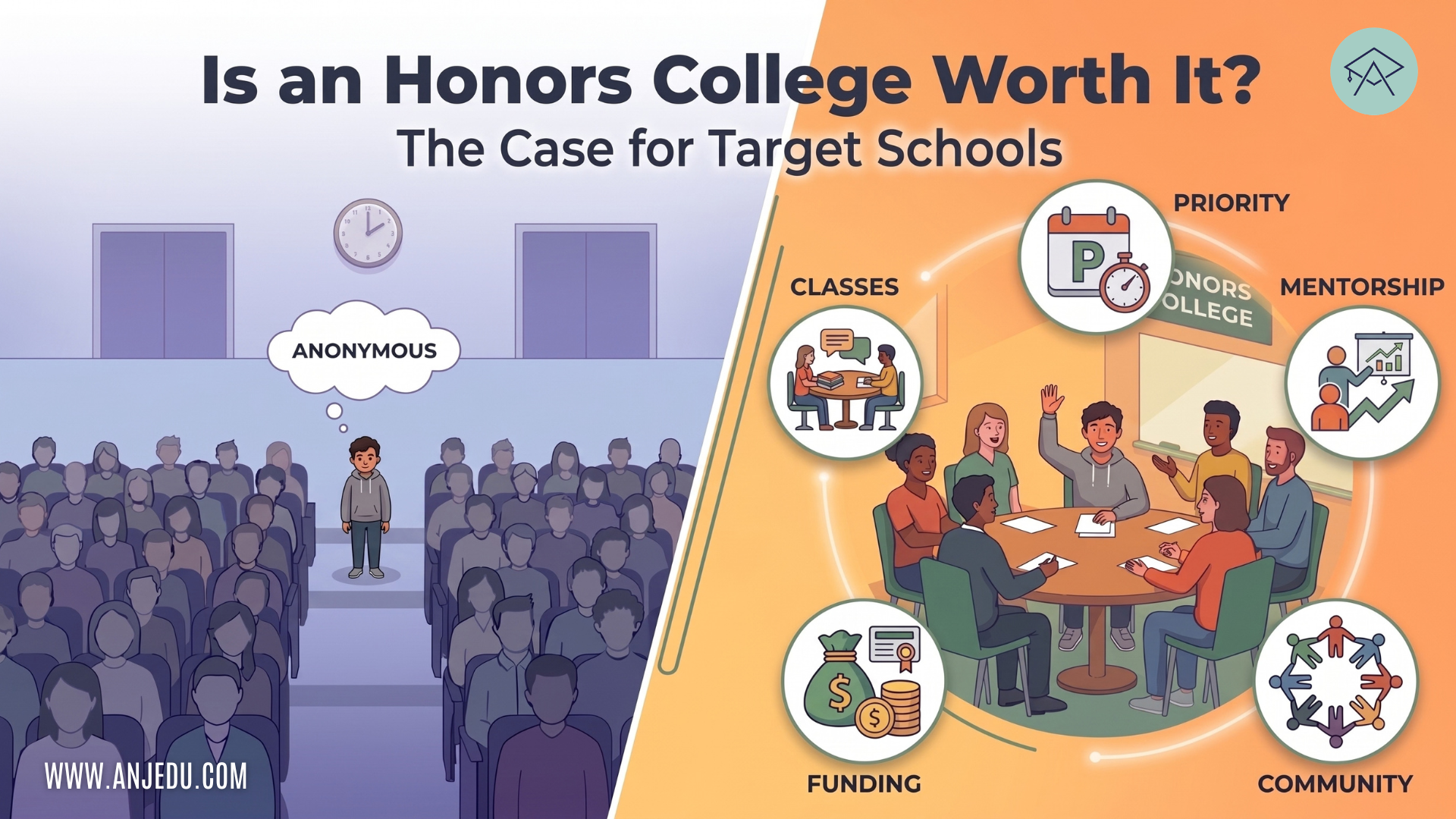
That reaction is understandable. Honors colleges do in fact vary enormously in quality, and some are close to nominal. But the good ones deliver what families believe they are buying with selectivity: small classes, faculty attention, and access. They deliver it at a fraction of the price and with far better odds of admission.
Here is how to tell which kind you are looking at, and why we tell families to build toward this outcome rather than settle for it.
On this page
- Is an Honors College Worth It? The Short Answer
- What Is the Difference Between an Honors College and an Honors Program?
- What Do You Actually Get From an Honors College?
- The Priority Registration Argument
- The Honest Case Against Honors Colleges
- How Do You Tell a Strong Honors College From a Weak One?
- Why Target and Likely Schools Are Where This Works
- How Do You Apply to an Honors College?
- Honors College Versus a More Selective School
- Frequently Asked Questions
Is an Honors College Worth It? The Short Answer
Often yes, and the variation between programs is enormous. Evaluate the specific one, not the category.
The core benefit is access: small seminar classes, faculty who know your student, and a defined cohort inside a large institution.
Priority registration is underrated and is worth real money in graduation timing.
Merit money frequently travels with honors admission, sometimes automatically.
The published outcome statistics are flattering and misleading. Honors students were stronger before they enrolled.
There are real costs: additional coursework, a thesis or capstone at many programs, a GPA you must maintain, and at a growing number of schools, a dedicated honors fee.
Honors admission is realistic at target and likely schools, which is exactly where the merit money also concentrates.
Many honors colleges have a separate application and a separate, earlier deadline.
A strong honors college beats a marginally more selective school without one, most of the time.
What Is the Difference Between an Honors College and an Honors Program?
Both exist, the labels are used loosely, and the difference is structural.
An honors college is an administrative unit within the university, with its own dean, staff, budget, advising, and often its own housing. It functions as a small college inside a large institution. The National Collegiate Honors Council counted 248 honors colleges nationwide in its 2021 survey, up from 24 in 1994, and roughly 84 percent of them sit at public universities. So the practical number of public honors colleges is somewhere north of 200, and still climbing.
An honors program is a curricular track rather than a separate unit. Students complete honors coursework while enrolled in whichever college houses their major. Perks are often similar but typically thinner, with less dedicated staff and less community.
Departmental honors is a third thing: a research or thesis track within a single major, usually entered in junior year. It is a different animal entirely and can coexist with either of the above.
Do not decide based on the label. A well-resourced honors program at one university can be substantially better than a thinly staffed honors college at another. The evaluation checklist below is what actually separates them.
What Do You Actually Get From an Honors College?
The common benefits, roughly in order of how much they matter to a typical student:
Small classes. Honors sections commonly run fifteen to twenty-five students, often seminar-style and discussion-driven, at universities where the standard introductory course seats three hundred. This is the single largest difference in day-to-day experience.
Priority registration. Honors students frequently register first, or among the first, each term. More on why this matters below.
Dedicated advising. An advisor with a small caseload who knows your student's name and field, rather than a general advising office serving thousands.
Faculty access and research. Honors colleges are typically built around getting undergraduates into faculty research early, and some attach funding to it in the form of research or project grants.
A cohort. Honors housing, shared coursework, and programming produce a smaller social world inside a very large one. For a student worried about disappearing at a big university, this is the answer.
A thesis or capstone. Listed here as a benefit because it is one, for graduate school applications and for job interviews, though it is also a requirement.
Scholarship access. Honors admission is frequently bundled with merit money, and honors offices often help students compete for national fellowships.
The Priority Registration Argument
This benefit sounds bureaucratic and is worth the most money.
At large public universities, required courses fill. A student who registers late can miss a prerequisite, which pushes the sequence, which pushes graduation. An extra semester costs tuition, fees, housing, and a delayed salary. An extra year costs considerably more.
Priority registration is a structural hedge against that. It is not glamorous and it will not come up on the campus tour, but across four years it is frequently the benefit with the clearest dollar value attached.
Ask directly on any campus visit whether honors students register first, and whether that priority holds all four years or only in the first year.
The Honest Case Against Honors Colleges
Any article that only lists benefits is telling part of the story. Here is the other side.
The outcome statistics are contaminated by selection bias. You will see claims that honors students graduate at much higher rates and earn more. They do. They also arrived with higher grades, higher scores, and more academic momentum than the general student population. Almost none of the published comparisons control for that. The honest claim is that honors colleges provide better conditions, not that they produce a measurable independent boost in outcomes.
The requirements are real. Additional honors credit hours, often a thesis or capstone, sometimes a foreign language or study abroad expectation. For a student in a demanding major like engineering or nursing, that load can genuinely conflict.
There is a GPA floor to maintain. The threshold varies more than families expect, from about 3.0 to 3.5, and many programs step it up as the student progresses. Alabama and New Hampshire hold students to a 3.5. Missouri sets it at 3.3. Connecticut starts at 3.0 in the first year and climbs each year after. A student who falls below the line can be placed on probation or dismissed, which is deflating and occasionally costs the attached scholarship. Look up the specific number and the specific schedule before enrolling.
Some honors colleges now charge a fee. This is newer and it is easy to miss. Alabama, for instance, began charging honors students a $300 per semester enrichment fee with the class entering in fall 2025. Ask what the fee is and whether the scholarship offsets it.
Some programs are nominal. A handful of honors sections, a line on the transcript, and little else. These exist, and they are marketed identically to the good ones. The checklist in the next section is how you tell.
Honors housing is not universally a plus. Some students want distance from an all-academic social environment.
Employers may not care, but graduate programs will. Graduate programs notice a thesis. Most employers will not distinguish an honors graduate from any other graduate of the same university. Choose it for the education, not the credential.
How Do You Tell a Strong Honors College From a Weak One?
Ask these questions on every campus visit and information session. The answers separate the substantive programs from the branded ones quickly.
- How many honors course sections run each term, and in which subjects? A program with plenty of honors sections in humanities and almost none in your student's field is not going to serve them.
- What is the average honors class size?
- Are honors courses available all four years, or is it a first-year and sophomore experience that fades?
- Do honors students get priority registration, and for how long?
- What is the advising ratio?
- Is honors housing available beyond freshman year?
- Is a thesis required, and what percentage of entering honors students actually complete the program? This last number is the most revealing one on the list, and the least frequently volunteered.
- Does honors admission carry scholarships, and is that award separate from or in addition to other merit aid?
- Is there an honors fee, and what does it cover?
- What is the GPA required to stay in, and does it rise by year?
- Can a student in my major realistically do this? Ask an honors student in that major, not the admissions office.
Why Target and Likely Schools Are Where This Works
Now the strategic part.
Honors admission depends on where your student sits in the applicant pool. At a university admitting 8 percent, your strong student is average within the pool, and there is no honors track that changes that. At a university admitting 60 percent, the same student is near the top, which is exactly the profile honors colleges recruit and pay for.
That is the same positioning logic that governs merit money, and it is not a coincidence that the two arrive together. Schools use honors admission and scholarships as instruments to attract students they consider above their typical admit. Your student's application is worth more at those institutions, in both senses.
One student we worked with, a homeschooled debater with strong grades and a 1460 SAT, was admitted to the honors college at a large university with $96,000 in scholarships across four years. Nothing about that outcome required a reach school. It required being clearly at the top of the pool at a school that wanted him and that fit all of his other preferences.
This is why we tell families to lean into their targets and likelies rather than treating them as an obligation. A list weighted toward lotteries can produce acceptances and almost no money, and no honors access at all. Six likelies and targets, three of them likelies, is the base we build almost every list on, and the honors and merit outcomes are the reason. The full framework is in our guide to how to build a balanced college list.
How Do You Apply to an Honors College?
Three things families miss, in order of how often they cost someone an opportunity.
Some honors colleges have a separate application and a separate deadline, often earlier than the general one. Track it in your deadline list as its own line, not as a footnote to the main application.
Some require additional essays, and some interview. Collect those prompts and word limits alongside the regular supplements so they are visible when you plan the essay schedule rather than surfacing in December.
At many universities, submitting the regular application automatically triggers honors and scholarship consideration. Check each school's site rather than assuming either way, because assuming wrong in one direction means a missed deadline and in the other means duplicated work.
On requirements themselves, there is no national standard. Some honors colleges publish hard thresholds for automatic consideration, usually a GPA and a test score. Others read holistically and weigh essays, rigor, and demonstrated intellectual interest alongside the numbers. Read the specific page rather than assuming your student does or does not qualify, because the published floor and the realistic admitted profile are often different numbers.
Two more points worth knowing. Test scores often matter more for honors than for general admission, including at universities that are test optional for admission, which is one of the reasons the test optional decision has to be made separately for admission, for merit, and for honors. And honors decisions frequently arrive later than admission decisions, so an acceptance without an honors answer is not necessarily a no.
Honors College Versus a More Selective School: How Do You Choose?
The actual April decision, and there is no universal answer. But there is a way to make it well.
Choose honors when the cost difference is meaningful, the honors college is substantive on the checklist above, your student's major is well served by it, and the more selective school offers no aid and no small-class access.
Choose the more selective school when it is affordable without significant debt, the specific program in your student's field is materially stronger, or the outcome data for that major is clearly better.
The tiebreaker is what your student will actually do there. The largest study on this question, Gallup's 2014 survey of roughly 30,000 college graduates conducted with Purdue, found that whether a graduate was engaged at work and thriving in life tracked far more closely with six specific college experiences than with where they went. Those six: a professor who made them excited about learning, a professor who cared about them as a person, a mentor who encouraged their goals, a long-term project, an internship or job applying what they were learning, and deep involvement in campus activities. Institution type and selectivity barely registered by comparison.
Two caveats, in the spirit of the selection-bias point made earlier. The survey is retrospective and self-reported, so it shows association rather than proof of cause. And only 3 percent of graduates strongly agreed they had experienced all six, which is less a knock on the finding than a warning that none of this is automatic anywhere.
Still, a strong honors college at a large university makes all six easier to reach than being an anonymous strong student at a more prestigious one.
The question is not which name carries further. It is where your student will be known.
Frequently Asked Questions
Is an honors college worth it?
Often, but the answer depends entirely on the specific program. A well-resourced honors college delivers small seminar classes, an advisor with a real caseload, priority registration, research access, and frequently a scholarship, at a public-university price. A thin one delivers a few honors sections and a transcript notation. The category tells you almost nothing. The checklist of questions above is what separates them, and the completion rate is the single most revealing number to ask for.
What is the difference between an honors college and an honors program?
An honors college is a separate administrative unit with its own dean, staff, budget, advising, and often housing. An honors program is a curricular track housed inside whichever college owns the student's major, usually with thinner staffing and less community. Departmental honors is a third thing entirely, a thesis or research track within a single major that students typically enter junior year. The labels are used loosely enough that a strong program can outperform a weak college.
How many public honors colleges are there?
The National Collegiate Honors Council identified 248 honors colleges nationwide in its 2021 survey, with roughly 84 percent of them at public universities, so somewhere north of 200. That number has grown steeply, from 24 in 1994. Hundreds more institutions run honors programs rather than colleges, which is one reason the two terms get used interchangeably in college marketing.
What are honors college admission requirements?
There is no national standard. Some publish hard thresholds for automatic consideration, typically a GPA and a test score. Others read holistically and weigh essays, course rigor, and evidence of intellectual curiosity alongside the numbers. Many require a separate application, additional essays, or an interview, and some have an earlier deadline than the general application. Read each school's honors page directly, because the published minimum and the realistic admitted profile are usually different numbers.
Do you need test scores for honors college admission?
Frequently yes, even at universities that are test optional for general admission. Honors admission and merit scholarships often run on separate criteria from admission, and scores are a common sorting mechanism in both. This is why the decision to submit or withhold has to be made three times, once for admission, once for merit, and once for honors, rather than once for the whole application.
What GPA do you have to maintain in an honors college?
It varies more than families expect, generally between about 3.0 and 3.5, and many programs raise the bar as the student advances. Alabama and New Hampshire require a 3.5. Missouri requires 3.3. Connecticut starts at 3.0 in the first year and climbs annually. Falling below usually triggers probation rather than immediate removal, but at some schools it can put an attached scholarship at risk. Look up the specific number before enrolling, not after.
Does an honors college cost extra?
Sometimes, and this is newer than most guides acknowledge. Alabama began charging an honors enrichment fee of $300 per semester for students entering in fall 2025, and other schools have similar fees. Ask what it covers and whether the honors scholarship offsets it. The net cost of an honors seat at a target school still tends to be dramatically lower than sticker price at a more selective private.
Do employers care about an honors college?
Mostly no. Most employers will not distinguish an honors graduate from any other graduate of the same university. Graduate and professional programs are different, because a thesis, faculty research, and a strong recommendation from a professor who actually knows the student all carry weight in that process. Choose an honors college for the education and the access, not for the line on the resume.
Honors college or a more selective school: which should we choose?
Choose honors when the cost gap is meaningful, the program is substantive on the checklist, the major is well served, and the more selective school offers no aid and no small-class access. Choose the more selective school when it is affordable without significant debt or when the specific program in your student's field is materially stronger. The deciding question is where your student is more likely to be mentored, do independent work, and be known by name.
Is it a step down to accept honors at a less selective school?
It is very commonly a step up in the things that actually shape the four years. A student near the top of the pool gets attention, funding, and access that the same student, sitting mid-pool at a more selective school, would have to compete hard to reach. That is the whole argument for building a list weighted toward strong targets and likelies rather than treating them as a fallback.
Ready to Talk?
If you want help identifying which honors colleges are worth your student's time, the Admission Strategy Session is a free call.Book here to talk it through with one of our advisors.
You can also ask AskAnji our admissions AI trained on the way we advise.
We're committed to supporting all students with free resources like this article. Join our community and receive powerful tips you can apply today as you build your list and prepare your applications. We've got you covered.
For the full process, start with our guide on How to Build a Balanced College List.