Common App Additional Information Section: What to Write
Aug 20, 2026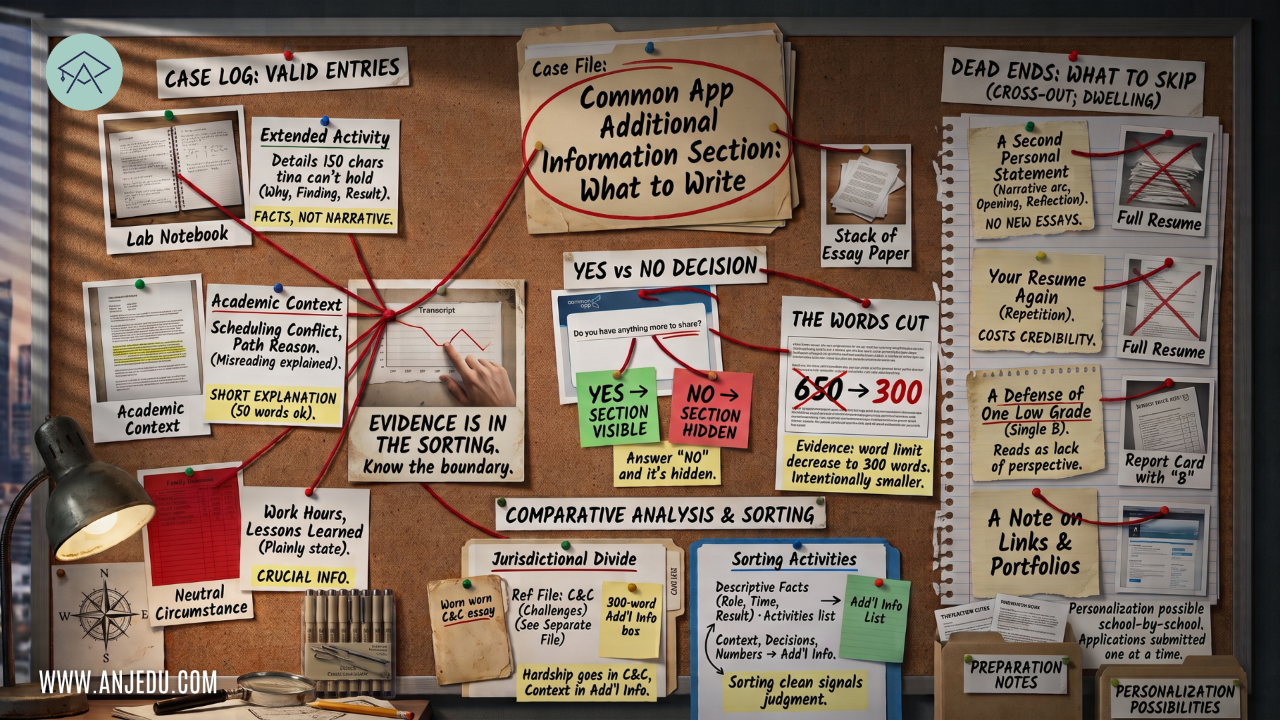
The Common App additional information section is either ignored or misused, and both are mistakes.
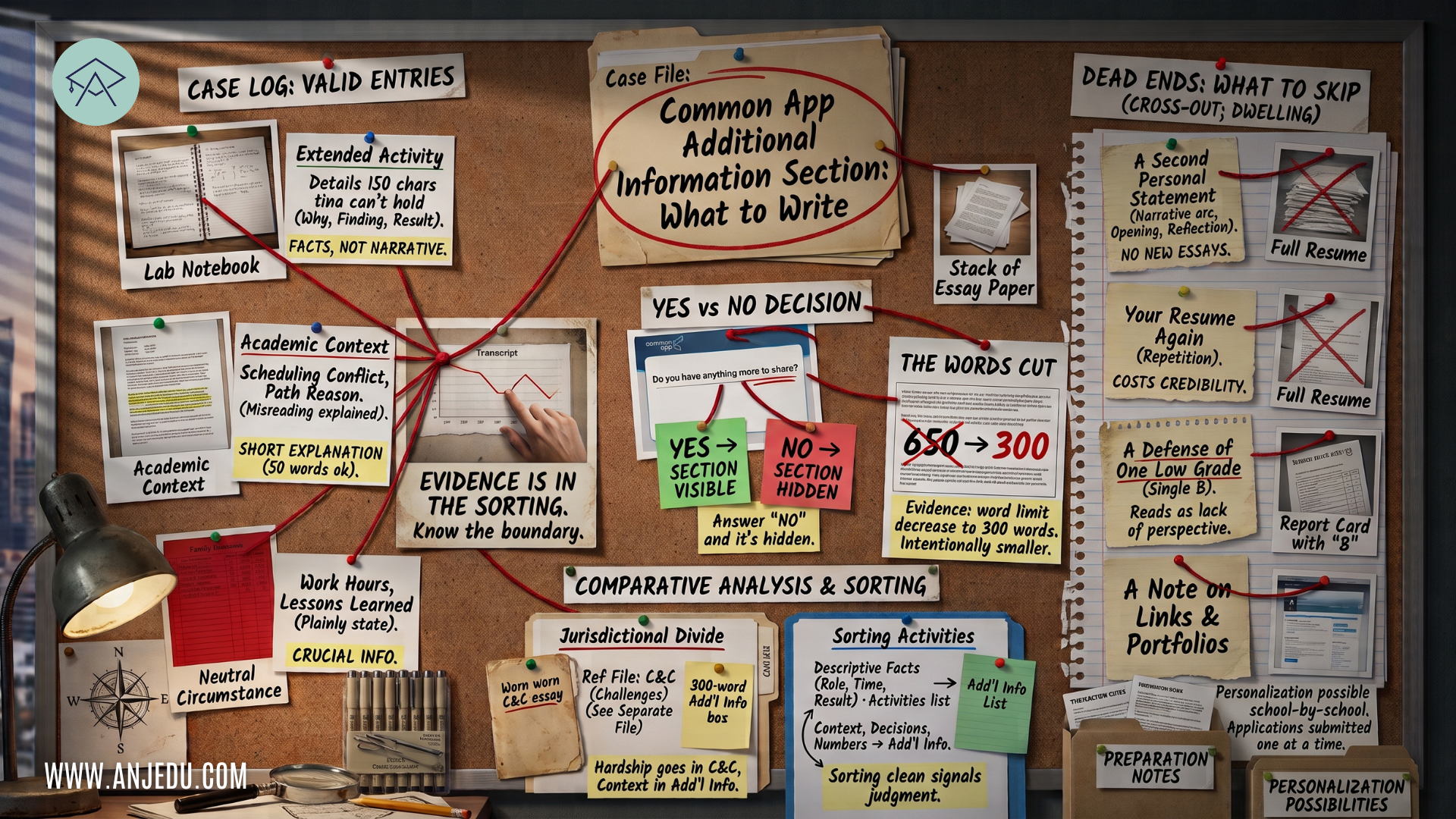
It's an optional box that appears right after the personal essay page — and only if you answer "yes" to the question asking whether you have anything more to share. Answer no and you'll never see it. That alone is why so many students skip past it without a thought.
But the bigger mistake is the opposite one: treating it as free space and filling it because an empty box feels like a wasted opportunity. As of the 2025-26 cycle, the section is deliberately smaller than it used to be, and that change tells you exactly how it's meant to be used.
What Changed: 650 Words Became 300
For years, first-year applicants had up to 650 words here — as much room as the personal statement itself. Starting with the 2025-26 cycle, that dropped to 300 words. (Transfer applicants get 1,500 characters.)
The cut was intentional. The longer box invited padding: students treated it as a second essay or an extended resume rather than a place for quick, useful context. Three hundred words is enough to explain something. It is not enough to write another personal statement — and that's the point.
A second change matters just as much. Hardship that shaped your academic record now has its own dedicated space, the Challenges and Circumstances prompt (250 words), which replaced the old COVID and community-disruption questions. That split changes what belongs in each box, and it's the single most useful thing to understand about this section.
Additional Information vs. Challenges and Circumstances
These two sit near each other in the application and get confused constantly. The division is clean:
- Challenges and Circumstances (250 words) — hardship that affected your record. Illness, a family crisis, housing instability, caretaking obligations, discrimination, a natural disaster.
- Additional Information (300 words) — everything else that needs context. An academic decision that looks odd without explanation, an activity that needs more room, a circumstance that's unusual but doesn't rise to hardship.
If your situation is a genuine hardship, it goes in Challenges and Circumstances. If it's context, explanation, or overflow, it belongs in the Common App additional information section. Some students use both. Most use neither.
The Other Question: Activities List or Additional Information?
Here's the decision students actually wrestle with, and it isn't really about hardship at all. It's about space.
You don't have one optional box — you have eleven: ten Activities List entries at 150 characters each, plus this 300-word box. So the real question is which sentence goes where.
If it describes a specific activity — something with a role, a time commitment, and a result — it belongs in the Activities List, even when 150 characters feels tight. Trim it to the load-bearing facts, or list it there and add a short pointer like "(see Add'l Info)," then expand here.
If it's context — something that helps a reader understand a decision, a gap, or a number that would otherwise look strange — it belongs in Additional Information. It isn't an activity. It's the sentence that makes an activity, a transcript, or a choice make sense.
Sorting cleanly is itself a signal. A student who dumps everything into this box because the Activities List felt cramped shows a reader the opposite of focus. A student who picks the two or three things that genuinely need explaining, and trusts the Activities List to carry the rest, shows judgment.
What to Write in the Common App Additional Information Section
Three kinds of entries earn their place.
An activity that needs more room
Some things are hard to compress for good reason — a research project with a methodology worth naming, a multi-year role with distinct phases, a self-directed project that doesn't fit a standard category. Keep the Activities List entry short and factual, then use this space for what 150 characters can't hold: the why, the specific finding, the result a reader can picture. It's not an essay. It's an extended fact.
Academic context that would otherwise look strange
If you made an unusual academic choice, or your transcript contains something a reader might misread, a short factual explanation beats silence. A scheduling conflict that forced you to choose between two AP courses. A course path that looks inconsistent but had a reason. Fifty words is often enough — answer the question a reader would otherwise have to guess at, then stop.
A circumstance that needs a sentence, not an essay
Not everything rises to the level of Challenges and Circumstances, and it doesn't need to. If you worked twenty hours a week at a family business and that's why your activities list is shorter than most, say so plainly — and note what the work taught you. That isn't an excuse. It's information the reader needs to read the rest of your application correctly.
That's the test for anything you're considering: does this help the reader understand something they'd otherwise misread, or am I just adding more?
What to Skip
Three things don't belong here (and one question mark). Cutting them is as important as what you include.
A second personal statement. If you're writing something with a narrative arc — an opening, a turn, a reflection — you're writing an essay, and this isn't the place for one. Readers have said plainly that if they wanted another essay, they'd have asked for one.
Your resume, again. If something is already in your Activities List, your personal statement, or your supplements, repeating it costs you credibility and buys you nothing.
A defense of one low grade. A single B doesn't need explaining. Readers know one grade doesn't define a transcript, and defending something minor reads as a lack of perspective. A semester-long drop tied to a real circumstance is different — and even then, one or two factual sentences will do.
A Note on Links and Portfolios. Some schools welcome them, others do not. The truth is that regardless of policy, readers often don't have time to click outside links. First try this: if an activity needs more space, expand on it in the text here rather than pointing somewhere else. But if you feel that the additional material is crucial, and if specific colleges allow link sharing, remember you can personalize this section school by school, since applications are submitted one at a time.
When to Leave It Blank
If nothing survives that filter, leave it empty. This is the part that separates using the section well from misusing it.
An empty Common App additional information section has never hurt an application. A crowded one sometimes has. Most students leave it blank, and plenty are admitted to highly selective schools having never touched it.
Before you decide, though, think it through properly. The bar isn't "do I have something I'm required to explain." It's "is there anything here that a reader genuinely needs in order to read my application correctly?" Make a list of every loose thread — an activity cut short, a gap, an unexplained number, an accomplishment with nowhere to live — and sort each one. Most will find a home in the Activities List. The ones that don't sort cleanly are usually the ones to leave out entirely.
The Bottom Line
This box rewards judgment more than writing. Know the boundary — hardship goes to Challenges and Circumstances, activities go to the Activities List, context stays here. Keep entries factual and short. Use the school-by-school personalization when it helps. And when nothing genuinely needs saying, have the discipline to leave the space empty rather than weaken a strong application with something the reader didn't need.
Most students never think this hard about a box they can barely find. Thinking this hard about it is exactly how it becomes an advantage.
Word limits and prompts change between cycles — confirm the current specifications at commonapp.org for your application year.
This is part of our series on the college essay. For the full picture — the personal statement, the supplementals, and every essay in between — see our main guide, The College Essay: Telling Your Standout Story.