College Essay Topics to Avoid (and How to Save Them)
Aug 13, 2026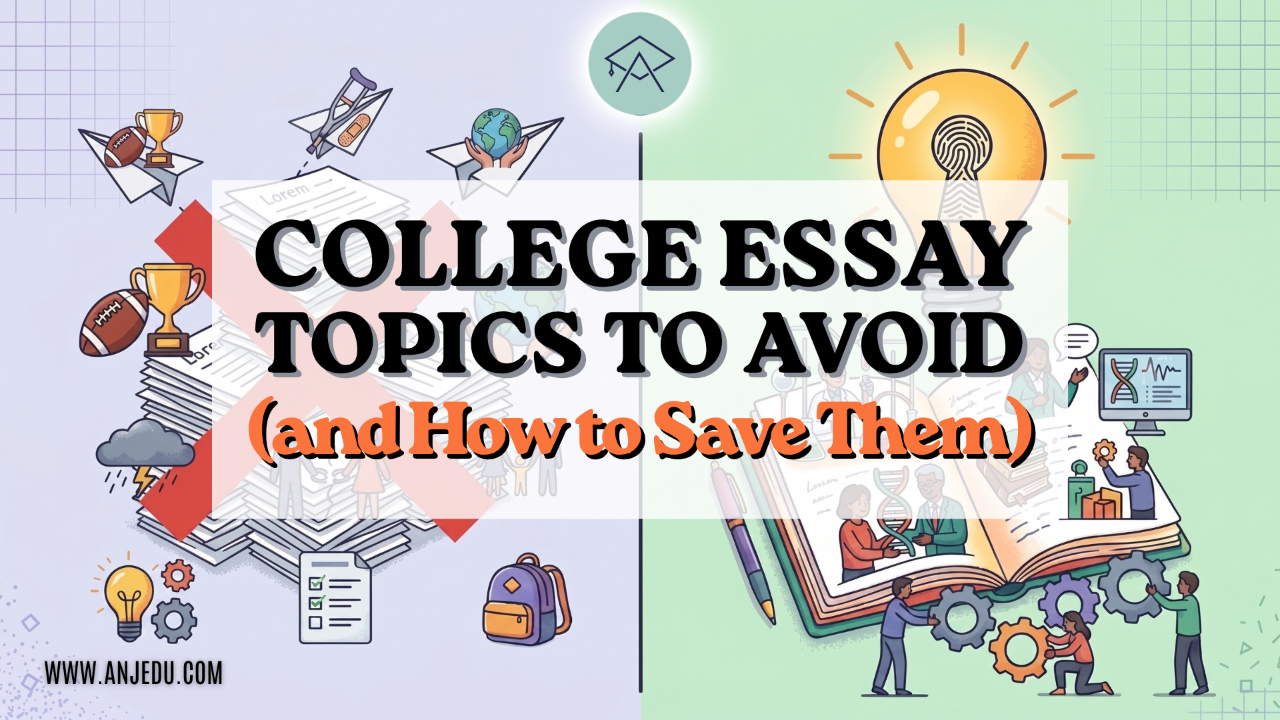
Every admissions reader has a mental stack of essays they've seen a thousand times. The winning touchdown. The injury and the comeback. The grandparent who taught them the value of hard work. These essays aren't badly written. They're invisible — and that's worse.
That's the real reason certain college essay topics to avoid exist. It isn't that the experiences don't matter; they almost always do. It's that meaning alone isn't enough. Your essay has one job: to make a fast-moving reader remember you specifically. A topic they've already read a hundred times this cycle works against that job before you've written a word.
Below are the topics we steer students away from, why each one is risky, and — because sometimes a topic genuinely is your story — how to rescue it if you decide to write it anyway.
Why Some Topics Are Riskier Than Others
Two different problems hide inside the list of college essay topics to avoid, and it helps to keep them separate.
The first is saturation. Some topics aren't dangerous, just crowded. So many students write about the big game or the service trip that readers have gone numb to them. You're not doing anything wrong — you're starting in a hole, working twice as hard to sound like an individual.
The second is risk. Colleges are run like businesses, and they're trying to reduce the odds of admitting a student who will struggle on campus. They invest in you and want that investment to pay off. When an essay centers on an ongoing hardship, some readers apply a quiet risk-analysis lens: will this student be okay here? One admissions dean described the applicants she turned away every year — strong grades, glowing recommendations, beautifully written essays about real pain — because she couldn't answer that question. That's not a judgment on the student. It's institutional caution, and it's real.
Knowing which problem a topic carries tells you how to handle it.
The College Essay Topics to Avoid
1. Common sports narratives
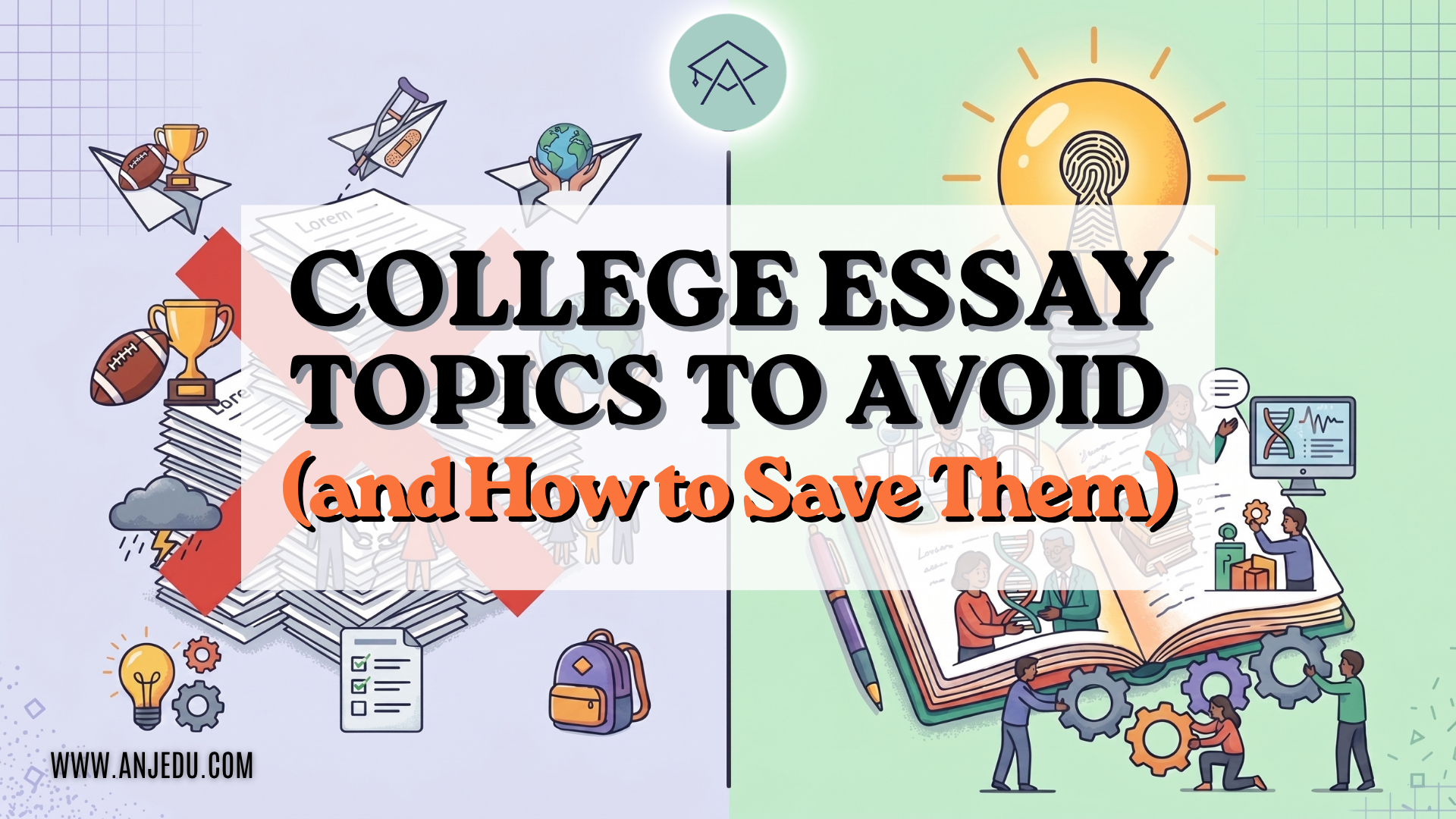
The buzzer-beater. The championship. What I learned from losing the big one. Pure saturation — deeply felt, endlessly repeated. Readers see hundreds of them, and most blur into the same arc of effort, setback, and lesson.
How to save it: get off the scoreboard. The essay rarely works when it's about the game; it can work when it's about something specific the sport revealed — a leadership role you grew into on the team, a relationship with a demanding coach, a moment nobody else saw. Journal until you find an angle that has nothing to do with winning or losing, and build there.
2. Injury recovery
Torn ligament, long rehab, triumphant return. Same saturation problem: the structure is familiar and the reader can predict the ending from the first paragraph.
How to save it: apply the 25/75 rule. No more than a quarter of the essay on the injury and the setback; three quarters on what came after — the specific strengths you built and how you've already used them. Then find the detail that isn't universal. Anyone can describe rehab. What did your recovery look like, hour by hour, that no other applicant's did?
3. The mission trip or eye-opening travel
The week abroad that changed everything. Seeing how much others have with so little. Beyond saturation, this one carries a second hazard: it can accidentally center your own privilege and flatten the people you meant to honor.
How to save it: turn the camera around. The strongest version isn't about how inspiring they were or how changed you felt in the abstract — it's about a concrete, ongoing action the experience set in motion back home, and what you specifically contributed. If the trip produced only a feeling, it isn't the essay. If it produced sustained involvement, write about that.
4. Mental health struggles
This is a risk topic, not a saturation one, and it deserves care rather than a flat rule. These experiences are real and significant. But they're genuinely difficult to handle in 650 words in a way that reads as strength rather than as a question mark about readiness.
How to save it: position it firmly in the past — something that happened to me, not something that is happening. Past tense signals perspective and resolution; present tense reads as ongoing risk. Hold to the 25/75 split, and make the heart of the essay the strengths and outlook you carry now, with evidence you've already put them to use. If you can't yet write it from a place of resolution, it may not be this year's essay — a strategic call, not a verdict on the experience.
5. Divorce and family upheaval
Common and heavy at once. Family disruption shapes people profoundly, which is exactly why it appears so often and why it's hard to make fresh without slipping into either melodrama or a list of grievances.
How to save it: don't narrate the divorce; narrate a strength it built. Keep the difficulty to a quarter of the essay, keep the tone neutral, and never bash a parent or anyone else — in a short essay, a swipe at someone reads as a flag about you. The three quarters that matter are the maturity, independence, or perspective you developed, shown through specific moments.
6. Learning differences
A meaningful part of many students' stories, and legitimately hard to write. Handled poorly it reads as a justification for lower grades; handled well it shows real self-knowledge and grit.
How to save it: focus forward. The 25/75 balance applies — a little on the challenge, much more on the systems, strategies, and strengths you built in response. And consider placement: sometimes the details belong in the Additional Information section as context, freeing your personal statement to be about who you are rather than what you've worked around.
7. The resume in paragraph form
A different failure with the same result. This is the essay that walks through your activities list in prose — president of this, captain of that, volunteer here. Not risky, not saturated, just wasted. Colleges already have your resume; repeating it spends your one open-ended section saying nothing new.
How to save it: pick one thread and go deep instead of wide. Don't summarize everything — take a single moment inside one activity and use it to reveal a strength the list couldn't show. Depth is what a resume can't give them.
8. Childhood stories
Examples should come from high school. A great deal changes between middle school and now, and colleges want to know who you are today, not who you were at nine.
How to save it: reference the early years in passing if they set up something, but keep the focus and the evidence firmly in high school. Your growth over the past four years is what admissions is actually evaluating.
What Every Rescue Has in Common
Look at the pattern across all eight. Not one of the fixes is "pick a more impressive topic." Every one is some version of: find the angle only you could write, cut the part that's common, and prove the rest with specific detail.
That's the real lesson buried in any list of college essay topics to avoid. There are very few genuinely forbidden subjects — even the risky ones can work with the right framing. What sinks an essay isn't the topic. It's writing the version a hundred other students are writing, in a voice that could belong to anyone.
The Test Before You Commit
Before you settle on a topic, ask one question: is this the essay only I could write?
If the answer is yes, even a crowded subject can shine, because the specificity of your telling will separate it from the pile. If the answer is no, that's your signal to keep digging until it is.
And if you're staring at this list convinced your own life is too ordinary to write about — most students feel that way — that's familiarity bias, not truth. You're so close to your own experience that you can't see its potential. Imagine a short film about one specific moment in your life. It doesn't have to be a thriller. It has to show growth. That's where a standout topic actually comes from.
This is part of our series on the college essay. For the full picture — brainstorming your topic, structuring your drafts, and telling a story only you could tell — see our main guide, The College Essay: Telling Your Standout Story.