College Essay Brainstorming: Find Your Topic Before You Write
Aug 06, 2026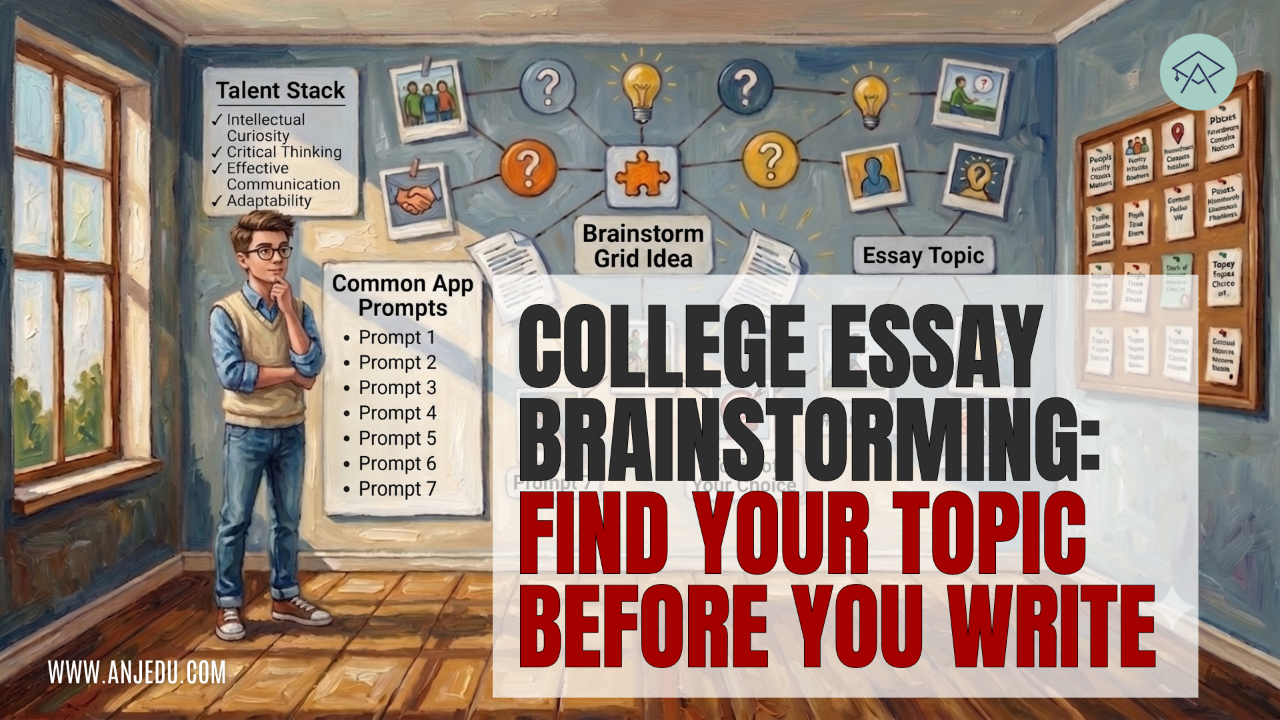
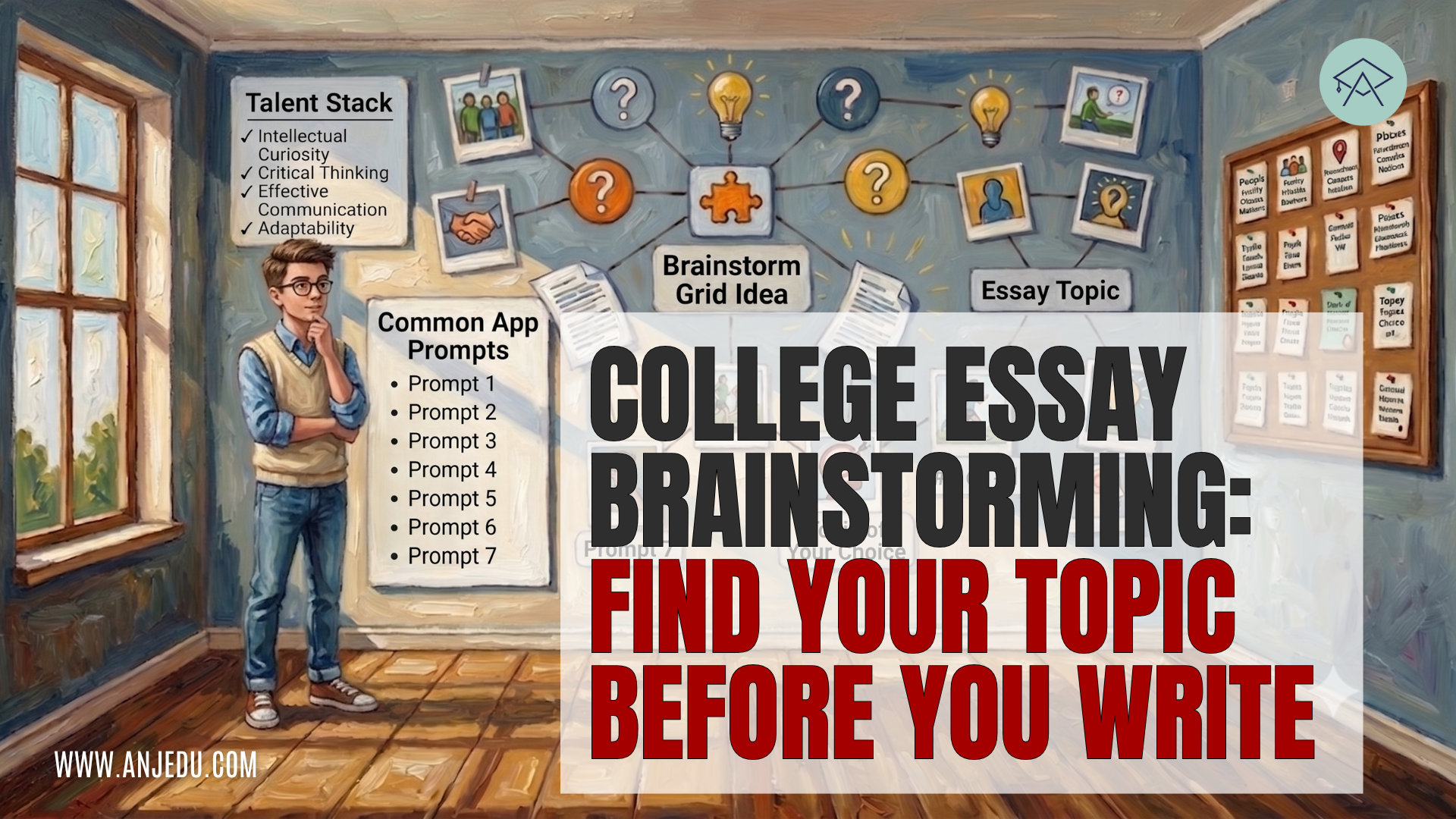
Most students begin college essay brainstorming in exactly the wrong place: staring at the seven Common App prompts, waiting for one to spark an idea, and feeling stuck when none of them does. It's a natural instinct — and it quietly limits you before you've written a single word.
We've found over the last decade that it's best not to start with the prompt, but with the raw material of your own life — the moments, people, and experiences you'd never think to put in an application. Once those are on the page, the right topic tends to surface on its own, and matching it to a prompt is the easy part. You always have prompt seven, "topic of your choice," so the prompt never has to come first.
Here's the exact process — question by question — that we walk our own students through.
Why Brainstorm From Your Own Moments, Not the Prompt
The reason is strategic. Underneath every prompt is one question: what character traits, strengths, and experiences will this student contribute to our community? Colleges already have your transcript, your scores, and your activities list. What they don't have is a specific moment that shows who you are.
Starting from a prompt sends you hunting for a story that fits the question. Starting from your own life gives you the story that's actually true — and the true one is always more specific, more surprising, and more yours. That's what good college essay brainstorming is really for: not generating clever ideas, but mining the moments you already have.
A note before you start: this stage takes real work, and it's meant to. Give it real time. The material you surface here doesn't just feed the personal statement — it feeds your supplementals and interviews too.
Step One: Answer the Brainstorming Questions
The heart of college essay brainstorming is a set of pointed questions designed to jog loose the moments you'd otherwise overlook. Don't try to answer all of them. Pick at least five that pull at you, and write three to five sentences on each — right on the page, no editing.
Here are the questions that consistently surface the best material:
- What has been the hardest thing in your life?
- At what points have you felt inadequate, and how did you deal with those feelings?
- If you had to quickly replay your life, what moments would jump out above the others?
- What would you regard as your greatest victory?
- What utterly fascinates you?
- Which of your relationships have you worked at the hardest?
- Have you ever made a discovery that thrilled you?
- What is the funniest thing that has ever happened to you?
- What fills you with pride?
- What was the toughest problem you managed to figure out?
- Have you ever faced an ethical dilemma? How did you resolve it?
- What have you done that "they" said couldn't be done?
- What object or possession holds the most meaning for you?
- If you can't sleep at night, what's keeping you up?
- Which personal weakness have you worked on the hardest?
- Which experience really pulled you out of your comfort zone?
- When you close your eyes and picture a place that feels special to you, where is it?
- Have you ever experienced a "life-changer"?
- Does your family have any special traditions?
- Do you have any hobbies? What are they?
- How have you changed since ninth grade?
Notice how concrete these are. They don't ask what you value in the abstract — they ask for moments. That's deliberate. An essay is built from a specific scene, and these questions are how you find yours.
Step Two: Fill In the Brainstorming Grid
Some memories won't come out through questions. They come out through categories — which is what the grid is for.
Make eight columns: People (friends, family, role models, even enemies), Places, Communities, Experiences, Passions/Interests/Curiosities, Religion/Spirituality/Culture, Favorites (foods, colors, books, sports), and Objects/Possessions/Collections. Under each heading, fill in any word or phrase that comes to mind. Don't overthink it — speed is the point.
When you're done, go back and highlight what stands out, looking for three things:
- Things that surprised you — a memory you'd forgotten you had.
- Things that came up in more than one column — a person who's also a place, a passion that's also a community. Repetition signals importance.
- Connections between columns — where two entries link in a way you'd never articulated.
Then take three of your highlighted responses — a word, a phrase, or a connection — and free-write on each for five to ten minutes. No stopping, no editing, no judging whether it's good. This is where topics hide: the entry you keep circling back to, the memory that carries more feeling than you expected, the link between two things you'd never put together.
Step Three: Build Your Talent Stack and Background
Now bring in the lens that turns a moment into an essay-worthy moment: your talent stack — your particular combination of strengths, the specific mix that makes you a valuable contributor to a community.
Build it from what you already know about yourself, then ask family, trusted peers, and mentors what they think your top strengths are. The outside view catches things you overlook. When your list is done, make sure it includes a few in each of three categories:
- Personal strengths — determined, solution-oriented, a natural planner
- Social strengths — collaborative, extroverted, empathetic
- Mental strengths — a born researcher, abstract thinker, methodical
Alongside the stack, jot down your background elements — the parts of your heritage and history that shaped you. What is your cultural background? Have you lived abroad? Do you speak more than one language? What aspects of your family history changed how you see things? These often unlock a topic the questions and grid didn't reach.
The talent stack matters because the strongest essays reveal three to five of its aspects at once. A story that shows only one strength tends to feel thin. So as you look back at your questions, your grid, and your free-writing, you're hunting for moments that put several strengths on display.
Step Four: Draft Your Top Four Topics
Now you turn raw material into candidates. Look over the seven Common App prompts, reread your brainstorming answers, and choose your top four topics — but capture each one in a specific format that tells you whether it will actually work.
For each topic, fill in four things:
- The topic — a short label.
- The story — what actually happened, in a few sentences.
- The parts of your talent stack you developed through it — aim for three to five.
- Possible prompts — which of the seven it could answer (there's usually more than one, and prompt seven always fits).
Here's a worked example, so you can see the shape:
Topic: Building a computer from scratch Story: I learned coding in high school, but discovered my real passion building a computer from an empty desk up. I gathered components over a year with money from tutoring math, researching each part to save money and piecing together the history of computing as I went. Now I teach my math students to build their own. Talent stack developed: perseverance, curiosity, goal-orientation, patience, mechanical aptitude, teaching skills Possible prompts: #6 (a concept you find so engaging you lose track of time) or #7 (topic of your choice)
Do that four times. The format does the work for you: if you can't fill in three-to-five talent-stack strengths for a topic, it's probably too thin to carry an essay, and you'll see that before you've wasted a draft on it.
A few guardrails as you choose:
- Focus on what you learned, not how impressive the experience was. The best essays are about ordinary moments told with self-reflection.
- Show change — think "before and after," even if the shift was internal.
- Keep it in high school. Childhood can be mentioned in passing, but the focus stays on who you are now.
- Some topics are hard to make fresh — learning differences, divorce, substance abuse, severe mental health struggles, and common sports narratives ("lost the game, learned teamwork"). If a real hardship is central, keep it to no more than a quarter of the essay and spend three quarters on what you did about it.
Step Five: Pick Your Favorite and Write the Elevator Pitch
From your four, choose the one topic that best shows how you changed and reveals the most of your talent stack. That's your essay.
Then distill it into a single sentence — your elevator pitch, or thesis. It names the actions you took, the strengths those actions built, and why they matter. Like this:
Through my internship with the Environmental Working Group, my climate activism, and my research on biodegradable packaging, I developed the determination, communication skills, and scientific knowledge I'll need to help reverse global warming.
That sentence rarely appears in the finished essay word for word. Its job is to be your anchor — a way to keep every draft pointed at the same theme and the same handful of examples. Once you can write it, your college essay brainstorming is done: you know your story, you know the strengths it shows, and you know what it all adds up to.
A Quick College Essay Brainstorming Checklist
Before you move to a first draft, run through this:
- You answered at least five brainstorming questions in real detail.
- You filled in the eight-column grid and highlighted what surprised you, repeated, or connected.
- You free-wrote on three of your strongest entries.
- You built a talent stack (with input from people who know you) and noted your background elements.
- You drafted four topics, each with its story, talent-stack strengths, and possible prompts.
- You chose one favorite that shows change and reveals three to five strengths.
- You wrote a one-sentence elevator pitch to anchor the essay.
Check all seven and you're no longer staring at a blank page — you're holding the raw material for a real essay.
The Point of All This
The essay's only job is to show a college the strengths and character you'll bring to campus, through a specific moment only you could tell. You can't show what you haven't surfaced — which is why college essay brainstorming has to start with your own life, not with a prompt.
Answer the questions, fill the grid, free-write your way to the moments that matter, run them through your talent stack, and narrow four topics to one. By the time you finally look back at those seven prompts, you won't be searching for something to say. You'll be choosing which prompt best fits the story you already know you need to tell.
This is part of our series on the college essay. For the full picture — turning your topic into a story, structuring your drafts, and telling a story only you could tell — see our main guide, The College Essay: Telling Your Standout Story.