Challenges and Circumstances Essay: What to Write (and Skip)
Aug 17, 2026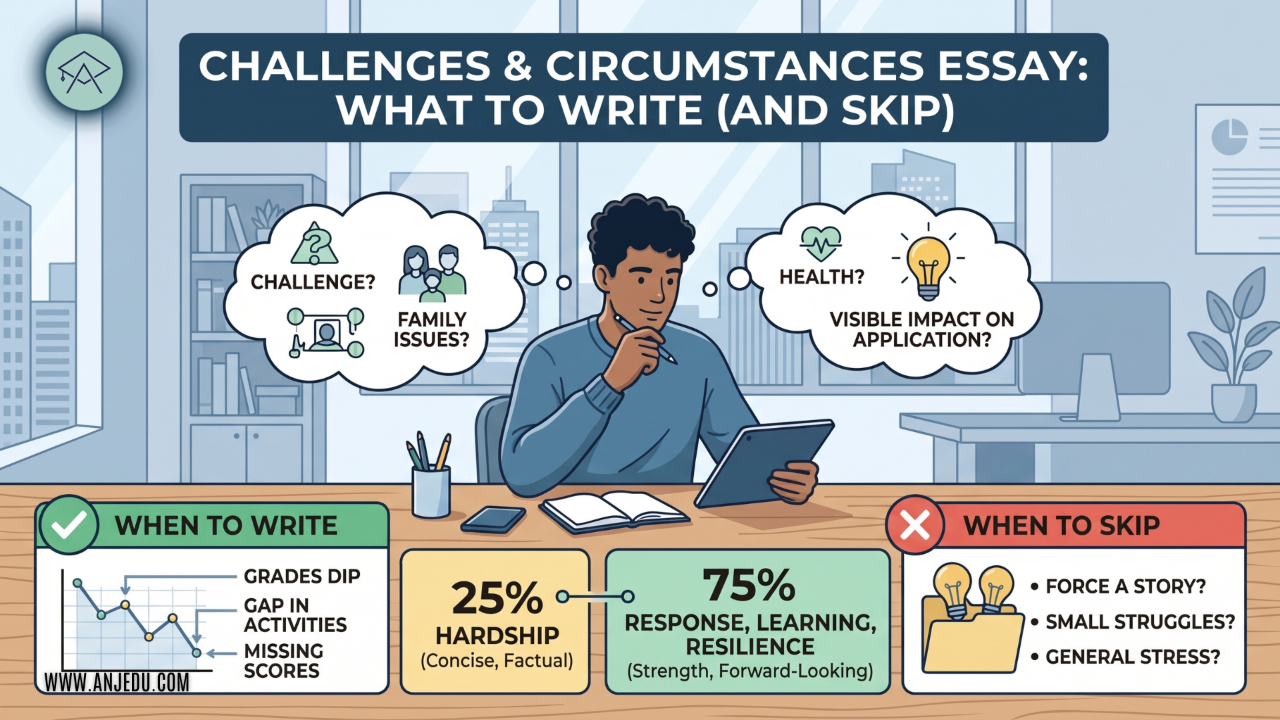
For the 2025-26 cycle, the Common App retired its old COVID and "community disruption" questions and replaced them with something broader: the challenges and circumstances essay. It's optional, it's capped at 250 words, and it sits in the Additional Information area of the application.
It's also widely misunderstood. Some students skip it when they genuinely should use it. Others force something into it because an empty box feels like a wasted opportunity. Both are mistakes — and the second one is worse.
Here's what this prompt is actually for, what belongs in it, and when leaving it blank is the right call.
What the Prompt Actually Says
The Common App frames it this way: sometimes a student's application and achievements may be impacted by challenges or other circumstances. It then lists what qualifies, and the range is wide:
- Access to a safe and quiet study space
- Access to reliable technology and internet
- Community disruption (violence, protests, teacher strikes)
- Discrimination
- Family disruptions (divorce, incarceration, job loss, health, loss of a family member, addiction)
- Family or other obligations (care-taking, financial support)
- Housing instability, displacement, or homelessness
- Military deployment or activation
- Natural disasters
- Physical health and mental well-being
- War, conflict, or other hardships
The application notes that if you're comfortable sharing, the information helps colleges understand the context of your application — and that colleges may use it to connect you with support and resources.
Two things to notice. First, this is far broader than the COVID question it replaced; it now covers personal and family hardship, not just community-wide events. Second, the words impacted and context are doing the real work. This isn't a prompt about hardship in the abstract. It's about hardship that visibly affected your record.
When to Write the Challenges and Circumstances Essay
Before anything else, ask: did this circumstance actually show up in my application?
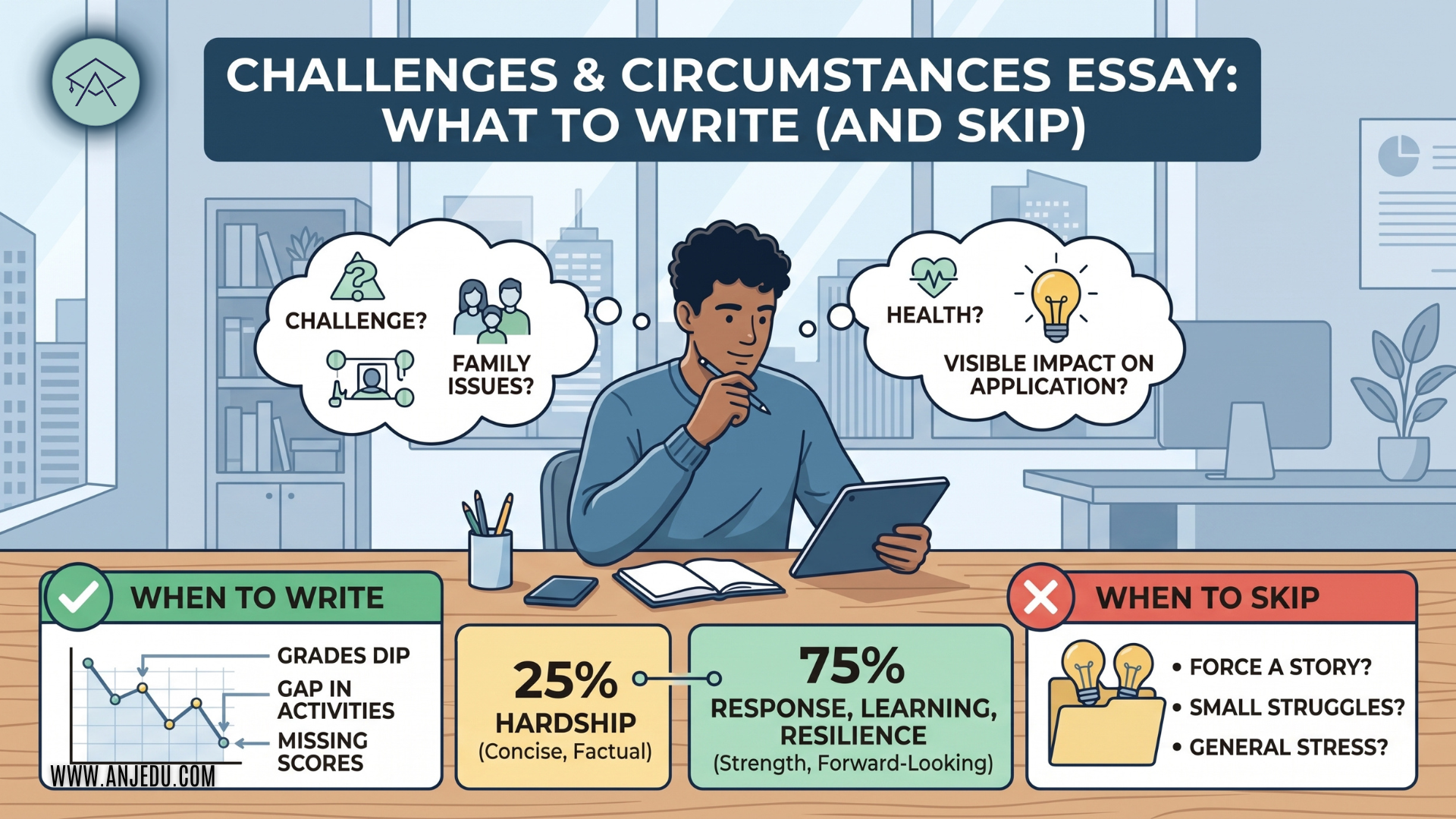
A dip in grades during a specific semester. A pause or drop in extracurriculars. Missing or low test scores. A gap that a reader would notice and, without explanation, interpret unfavorably. If a challenge produced a visible mark on your record, the challenges and circumstances essay is exactly where you explain it.
If nothing in your record needs context, you don't need this section. Universities ask the question because they want to understand applicants' experiences — but unless you genuinely faced extraordinary hardship, there's no obligation to answer. A blank response has never hurt an application. A contrived one can.
That's the filter. Visible impact on your record, caused by something outside your control.
What to Write: The 25/75 Rule
If you're writing it, structure matters as much as content — and the rule is the same one that governs any hardship writing in your application.
No more than a quarter of the space describes the difficulty. At least three quarters covers what came after — what you did, what you learned, and the strength you carry now.
In 250 words, that's roughly 60 words on the circumstance and 190 on everything else. That ratio feels wrong to many students, because the hardship is the part that loomed largest in life. But the reader needs only enough of the difficulty to understand the stakes. What persuades them is the person on the other side of it.
Three more mechanics:
Get to the point immediately. With 250 words, there's no room for a literary opening or a slow build. State what happened in the first sentence or two, plainly. This is not the place for the scene-setting craft you'd use in a personal statement — it's the place for clarity.
Position it in the past. Something that happened to me, not something that is happening to me. Past tense signals perspective and resolution. Colleges are quietly asking whether a student will thrive far from home, and an unresolved present-tense hardship invites doubt where a navigated past one demonstrates resilience.
Be specific and factual. Name the semester. Name what changed. Point to the recovery if there was one — a grade that came back up, a commitment you resumed. Specifics do the persuading; adjectives don't.
What to Skip
The challenges and circumstances essay fails in predictable ways.
Don't inflate a non-challenge. A hard week, a tough class, ordinary teenage stress — these don't belong here. Stretching a small difficulty into an existential crisis reads as exactly what it is, and a contrived response is far worse than a blank one.
Don't repeat your personal statement. If your main essay already covers the hardship, this section shouldn't retell it. In fact, the reverse is often the better strategy — see below.
Don't use it to bash anyone. A parent, a school, a person who wronged you. Even when that isn't your intention, 250 words flatten nuance, and criticism of others reads as a warning sign about you. Neutral language protects you.
Don't dwell on the problem. The most common failure is spending 200 of your 250 words on what went wrong. Flip it.
How It Frees Up Your Personal Statement
Here's the strategic upside most students miss.
Because a dedicated space now exists for hardship, you don't have to carry it in your main essay. Students often assume a serious challenge — a medical issue, a family crisis — has to anchor the personal statement. The problem is that doing so partially defines you by a negative experience rather than an affirmative one.
If the difficulty can live safely in the challenges and circumstances essay, your personal statement is liberated to be about something stronger: your talent stack, your growth, the thing you'd contribute to a campus. That's usually a better use of 650 words, and it's one of the clearest arguments for using this section when it genuinely applies.
Where It Fits Alongside Additional Information
These two sections sit near each other and get confused constantly. The division is straightforward:
- Challenges and Circumstances (250 words) — hardship that shaped your record. Illness, family crisis, housing instability, care-taking obligations.
- Additional Information (300 words) — the more neutral context. An unusual course path, an overflow activity, a scheduling decision that needs a line of explanation.
If you're genuinely unsure which one something belongs in, don't agonize. What matters is that the information reaches the reader somewhere in your application. And if your circumstance needs more than 250 words to explain properly, it's acceptable to use both spaces.
The Bottom Line
The challenges and circumstances essay is a context tool, not an essay contest. Use it when something outside your control left a visible mark on your record. Skip it when it didn't.
If you do write it, get to the point in the first sentence, keep the difficulty to a quarter of the space, spend the rest on what you did and what you carry forward, and stay factual and forward-looking throughout. Do that, and 250 words is plenty to turn what looks like a weakness into evidence of exactly the resilience colleges want to see.
Prompt wording and word limits change from cycle to cycle — confirm the current version at commonapp.org for your application year.
This is part of our series on the college essay. For the full picture — the personal statement, the supplementals, and every essay in between — see our main guide, The College Essay: Telling Your Standout Story.